
Agentic AI vs Generative AI: A Practical Guide for Businesses


There are few technologies that have had such a meteoric rise as artificial intelligence in recent years. At the same time, the market is becoming increasingly versatile, and the evolution of this tech is proceeding in several different directions.
The two main categories of AI are agentic and generative, each with its distinct uses in business, from content creation to process automation. Today, we’re going to look at this duo, highlight their strengths, note their differences, and discuss their future.
This guide outlines the practical differences between agentic and generative AI to support informed business decisions. Once those differences are clear, implementation becomes a matter of system design, technology choices, and team setup, including scenarios where companies hire dedicated Python developers to support AI-related work.
Definitions & Context
First things first, let’s define what agentic and generative AI are in simple terms.
What is Generative AI?
Perhaps the more common of the two and certainly the more accessible, a generative model is used to create new content using pre-existing information, patterns, and files. Massively popular products like ChatGPT and Midjourney belong to this category.
It’s important to note that this type of AI cannot function without first being trained on massive datasets and, crucially, receiving prompts and directions from users. In other words, it’s a reactive product, reliant on user input to deliver any results.
Generative AI is based on large language models (LLMs) and generative adversarial networks (GANs), which work behind the scenes to actually create the desired output. So, to sum up:
- Reacts to user input;
- Generates content;
- Easy to adopt.
What is Agentic AI?
On the other side of the coin is agentic AI, which is already a hit with the business sector. These systems are proactive rather than reactive, set up to autonomously perform tasks and run processes. While some oversight and supervision are still required, if only to handle the initial configuration and ensure it’s operating correctly.
These types of AI solutions use LLMs as well, but enhance their functionality with analytical and planning tools, as well as self-training. Thanks to that, this type of AI has more agency, which makes the name appropriate. However, the term’s use for AI models is relatively young and contentious, as it’s an older slang word in software circles.
Still, what matters most isn’t the name but what agentic AI can accomplish: automating certain business operations, running analytics, and helping companies minimize risks. To sum up agentic AI, it is:
- Self-sufficient and self-sustaining;
- Designed for business optimization;
- Complex and flexible.
One last thing before we move on, though. If you’re wondering about the difference between agentic AI vs generative AI vs AI agents, the above explains only the first two points. As for AI agents, they are all part of the agentic AI umbrella. But while the term “agentic AI” can refer to the general field of creating such systems, an “AI agent” is a specific system that has agency. So, basically, one is the industry term and the other refers to the product.
Core Differences
Now that we understand the two types of AI and their core features, let’s discuss what makes them different and how that affects their usability.
Function and Purpose
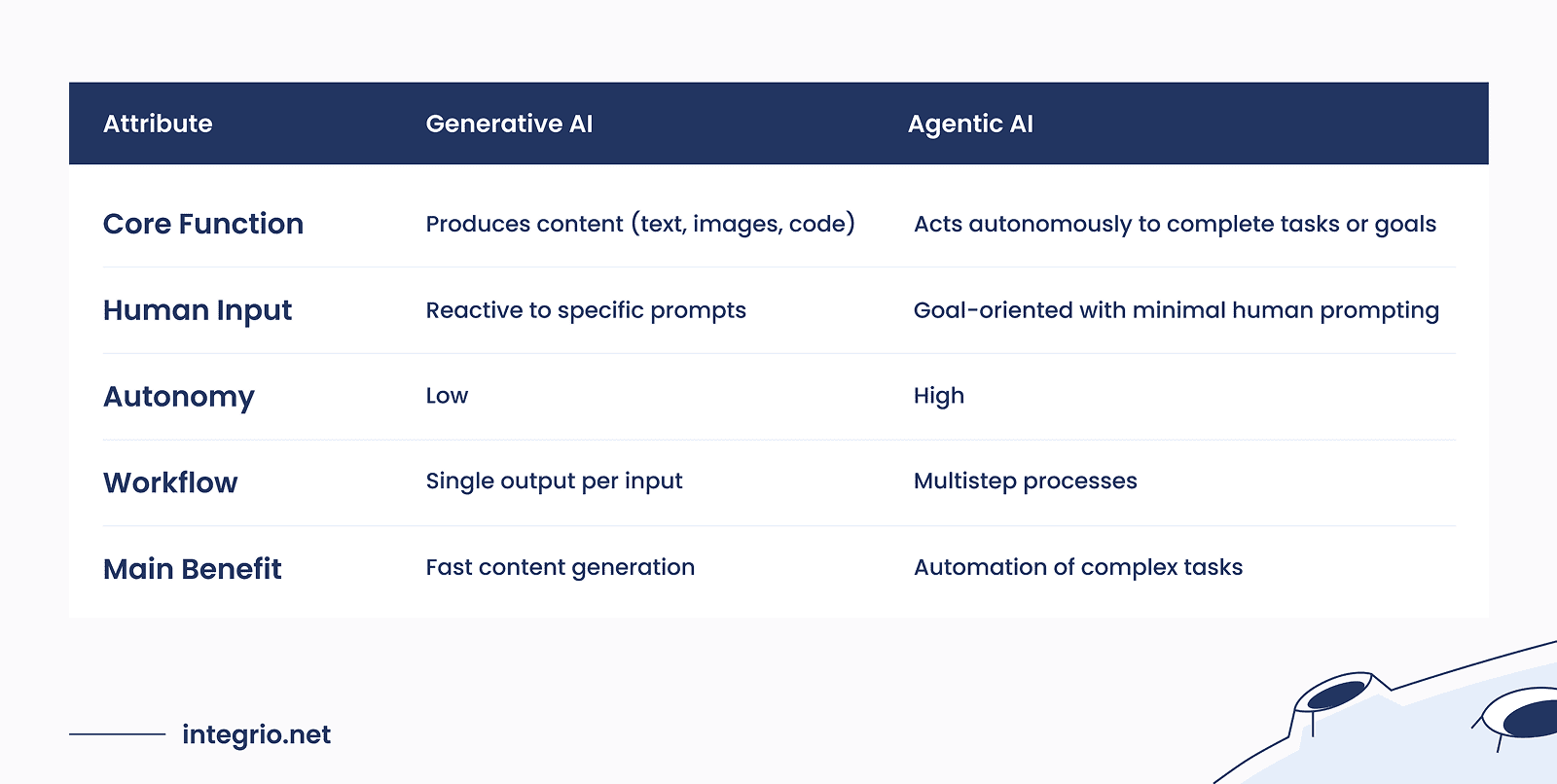
We have indirectly covered this above by listing the systems’ attributes, though not comparing them directly. Simply put, genAI is about creating new content, while agentic AI is more about task completion. It doesn’t necessarily result in anything new being created; rather, it just follows instructions to finish processes.
Reaction vs Autonomy
One of the biggest agentic AI vs generative AI examples is how they perform their basic functions. The latter is idle until a user prompts it to do something: create a reply, generate data, or analyze an input.
Meanwhile, agentic systems perform such functions autonomously, planning and executing tasks according to their initial instructions. Should a user input some new conditions and prompts, the agentic AI will process them and adapt accordingly.
Complexity & Workflow
When it comes to working with genAI, users should expect rather basic functionality, such as:
- Summarizing blocks of text;
- Editing existing images and writing;
- Answering questions.
As for agentic AI, it can handle multistep tasks, fulfill conditions, plan ahead, and generally follow much more complicated sequences, as well as show initiative. This doesn’t mean it could run a whole company, of course, but it can still perform some complex duties that humans previously handled.
Technology Stack
We’ve already mentioned that both types of AI use LLMs at their core. However, while genAI typically uses the model primarily to generate outputs in response to prompts, agentic systems go further. These systems include orchestration and planning capabilities, provide memory storage, and integrate a variety of tools and external software.
Use Cases & Industry Applications
Based on the differences we’ve laid out above, it’s clear that the actual applications of generative and agentic AI are vastly different. This section will illustrate what the typical use cases are and help you find the path forward for your own AI journey.
Generative AI Use Cases
First up, genAI and its current applications. We say “current” because this is very much a developing industry, and we may see more use cases as it evolves. For now, though, the core uses are these:
- Content creation;
- Building document drafts and summaries;
- Brainstorming sessions, idea validation;
- Rapid content iteration.
Creating content with genAI can be useful for marketing efforts, allowing brands to instantly push promotional materials featuring their logo and identity, targeted at any number of people. Being able to quickly iterate and change how that content looks means that it can be easily tailored. As a result, your company can tackle multiple social platforms and target groups using just a few prompts.
However, genAI can also be useful for other processes, such as building knowledge bases or sharing reports. By quickly summarizing massive documents and files, it allows people to get the essentials in a minimum time. This speeds up onboarding, keeps employees in the loop, and turns documents into structured, searchable records for long-term use.
Next, genAI doesn’t have to handle all content creation on its own. It serves as a handy partner to bounce ideas off of, as your team can pitch designs and content to it. The model will then assess it, provide criticism, or offer ways to improve and refine the idea. Having this extra voice in the discussion can prove crucial, especially when it’s trained on plentiful market data.
Examples of these uses include brands like General Motors running virtual assistants based on genAI and Uber automating small document drafting. When looking at data, it’s clear that pretty much every large company out there has embraced this trend.
Agentic AI Use Cases
As for agentic systems, they already have a very broad range of applications, but remember, the “AI agents” is also a quite general term. Unlike generative models, agentic models can be trained for a wide range of purposes. However, break them down into more precise sub-types, and you’d have a more restricted choice of use cases.
Still, when talking about agentic AI in general, its current applications include:
- Workflow automation;
- Autonomous research and analytics;
- Integration with enterprise systems;
- Decision support and real-time adjustments.
Automating business processes with AI enables high-quality work with minimal involvement from human employees, who can focus on more complex tasks. AI allows truly smart automation of routine operations that’s based on your company’s own data. This way, you ensure it continues to self-improve and may become viable for more in-depth work.
Similarly, AI can run multi-level research operations to analyze your business and the market at large. This allows companies to estimate their prospects, minimize the risk of new ventures, and plan their future expansion or new directions. The upside here isn’t just the fact that all these analytics are run in the background. AI can process far more data than even a full team of employees could, yielding deeper insights.
Next, agentic systems can be integrated with your existing enterprise-grade software for automation, maintenance, or additional functionality. The former is simple enough, as AI tools can handle invoicing, scheduling, customer support, and more. As for maintenance, these systems can predict when it will be necessary, assess the status of your equipment, and alert staff.
Lastly, based on the above applications, AI can be a deciding factor in adjusting your projects, changing the company’s course, and launching new products. As it learns and trains, it will understand your business precisely and suggest new ideas in real time.
Benefits and Limitations
As with any technology, AI comes with both strengths and shortcomings. This section illustrates them to ensure we’re presenting a realistic picture of AI for business use.
Benefits of Generative AI
First and foremost, genAI speeds things up, even if it doesn’t automate them. It delivers unique content instantly, helps process rough drafts into usable documents, and enhances marketing. This bump in productivity is already a massive benefit, but it’s not the only one.
GenAI also ensures that your company doesn’t get stuck on minor problems, offering varied solutions and helping validate ideas and plans. In other words, you can turn AI into an engine that fuels your growth.
Benefits of Agentic AI
Now, agentic AI, being a rather general definition, can have very disparate benefits. Its core business use is automation of all levels, from simple operations to multi-stage processes. Based on this, agentic systems also integrate the results of their work into the client ecosystem, such as applying analytical data to make instant decisions based on business context.
In short, the core advantage of agentic AI is its potential to optimize your day-to-day operations, taking a large share of the workload off your staff.
Limitations / Risks
In addition to their strong benefits, both generative and agentic AI carry certain risks and shouldn’t be viewed as some boundless tool that can accomplish anything. For example, genAI is currently prone to “hallucinations,” the model producing error-prone outputs. Without additional manual verification, this could result in you relying on imprecise data.
The lack of standardization and accuracy also means that genAI may require a bit of extra work to get your content output just right. However, this is nothing compared to the trouble of the initial setup that more complex agentic systems present. Supervising their work can also pose difficulties, though it’s still easier than shouldering those tasks yourself in the long run.
More importantly, agentic AI needs a lot of thoroughly processed data to actually work, slowing its implementation and progress. However, the end result more than justifies this work.
Emerging Challenges & Considerations
AI must be compliant with a slew of regulations, some of which limit its usability. Still, it’s important to follow them in order to keep your ecosystem secure and avoid legal issues. To ensure your data’s security and quality, you need a strong team. However, there are a few other things to keep in mind.
First, dedicate time to analyzing your system’s ethics, including data sourcing and how the AI's suggested decisions could impact people. Models aren’t primed to “think” of that by default, so this task is left up to you.
Plus, it’s essential to recognize that, just like any hyped-up industry, AI should be treated with tempered expectations. Don’t assume that a product promising revolutionary results can or will deliver them in your specific case.
Practical Implications
So, the big question is, which one should you use, agentic or generative? Well, if you seek marketing content, idea validation, and simple support bots, generative is the way to go. If it’s more about optimizing internal processes, automating work, and deepening analytics, choose agentic.
Either choice must be implemented by professionals and geared toward a clear, specific goal. Know why you’re using AI, who’s in charge of controlling it and overseeing the results. Basically, take the lead and pave your own way. In a similar vein, remember that nobody can stop you from outright combining agentic and genAI to get unique content that’s later processed by another system.
Conclusion
So, to sum up, your path with AI is yours to shape, using top teams to build systems that fit your purposes and work reliably with your environments. While some may choose generative, and others prefer agentic, both types of AI have inherent value. Generative is the perfect content tool and virtual assistant, while agentic is essential for optimization and automation.
Plus, don’t forget that modern AI is still relatively young as far as technology goes. The next few years will surely bring many new developments, including fresh models of hybrid AI and more. So don’t stop experimenting and looking for novel ways to boost your business with AI. Integrio is here to help you along the way and make your AI ambitions become reality.
FAQ
GPT, or generative pre-trained transformer, is a type of LLM and therefore belongs firmly to the class of generative AI. It’s a comparatively simple, user-driven system and doesn’t have the same agency or functions as an agentic tool.
This is an interesting consideration, as Copilot’s most common uses are all generative, which may make it seemingly easy to categorize. However, in reality, this model possesses some agentic qualities and functions, making it a mix of the two AI types. It still leans harder toward gen uses but should not be considered 100% generative.
Yes, and it is probably the most prominent example of this category, with 2.5 billion prompts per day. It’s a good proof of how widely adopted and commercially viable generative AI systems have become.
One of the better-known examples is Senseye, acquired by the tech giant Siemens. The platform helps them reduce downtime, manage predictive maintenance, and lower operational costs. Similarly, the Bank of America uses AI for customer support, fraud detection, and workflow scheduling.
Contact us
