
AI Analytics in Healthcare: The Cost of Building from Pilot to Full Deployment


Cancer detection, cardiovascular health monitoring, customized treatment plans, genomic analytics. Those are just a few use cases of artificial intelligence analytics in healthcare. The existing systems already provide spectacular results - but at what cost? Which healthcare organizations can afford this new technology?
In this blog post, we will do our best to answer these questions. Read on to learn about the healthcare AI analytics cost for a pilot project and a full-scale implementation, and the key factors driving it up.
Why AI Analytics Is Growing in Healthcare
Artificial intelligence, particularly AI analytics, is changing how healthcare institutions operate, benefiting both staff and patients. Here is what it brings to the table.
Operational Efficiency
Healthcare organizations generate enormous amounts of data daily, yet much of it goes underused. AI analytics changes that by aggregating information across departments and surfacing patterns that signal inefficiencies. For example, algorithms can detect repeated documentation errors, claims likely to be denied, or unusual spikes in resource consumption.
Clinical Decision Support
Algorithms boost diagnostic accuracy, enhancing the detection of strokes, tumors, and other critical conditions. In particular, AI can spot patterns in medical imaging that a human eye may miss. Smart tools generate targeted treatment plans based on genetics, medical history, and lifestyle factors. Besides, they can identify high-risk patients for readmissions or complications.
Forecasting Demand and Staffing
Healthcare forecasting software predicts patient volumes, helping healthcare providers allocate resources and plan shifts more efficiently. Such dynamic scheduling reduces staff burnout and lowers nurse turnover. Anticipating admissions and discharges more accurately allows hospitals to reduce the average length of stay and manage beds more efficiently.
Revenue Cycle Optimization
Claim denials are rarely random. The same documentation gaps, the same payer quirks, the same coding mistakes tend to show up again and again. The problem is that spotting those patterns manually, across thousands of claims, is not realistic for most billing teams. AI analytics helps to find where revenue is consistently slipping and why, connecting the dots across denial records, payer behavior, and billing history.
Patient Experience Improvements
Patient satisfaction scores often tell you something went wrong, just not what or why. AI analytics fills that gap by tracking behavioral patterns like missed appointments, dropped care plans, and response rates to follow-up messages. Over time, these signals reveal where the experience breaks down for specific patient groups.
What Counts as a Pilot in Healthcare AI
A pilot is a limited trial to test how well a new AI solution fits into real healthcare workflows. Starting small allows organizations to mitigate the risk of disrupting operations and misplaced investments. A typical AI pilot usually includes:
- Limited department rollout. If AI fails within one department, the consequences are easier to manage than after a hospital-wide debacle. A single team can try the new tool and provide feedback to refine it. In case the trial goes well, it secures "social proof" to smooth further implementation.
- One use case only. It helps measure KPIs clearly, such as reducing administrative time or improving the accuracy of identifying a specific condition. Also, a focus on a single use case usually makes it easier to provide AI with high-quality datasets.
- Historical data testing. AI should prove its worth on past records before it's allowed into real clinical environments. Healthcare professionals compare the AI predictions against known outcomes, which is fast and safe.
- Basic dashboards or predictions. Ideally, hospital AI dashboards should move beyond passive data reporting to support decisions, for instance, by flagging risks. Predictions are easy to assess, providing clear-cut success metrics.
Typical Cost of a Healthcare AI Pilot
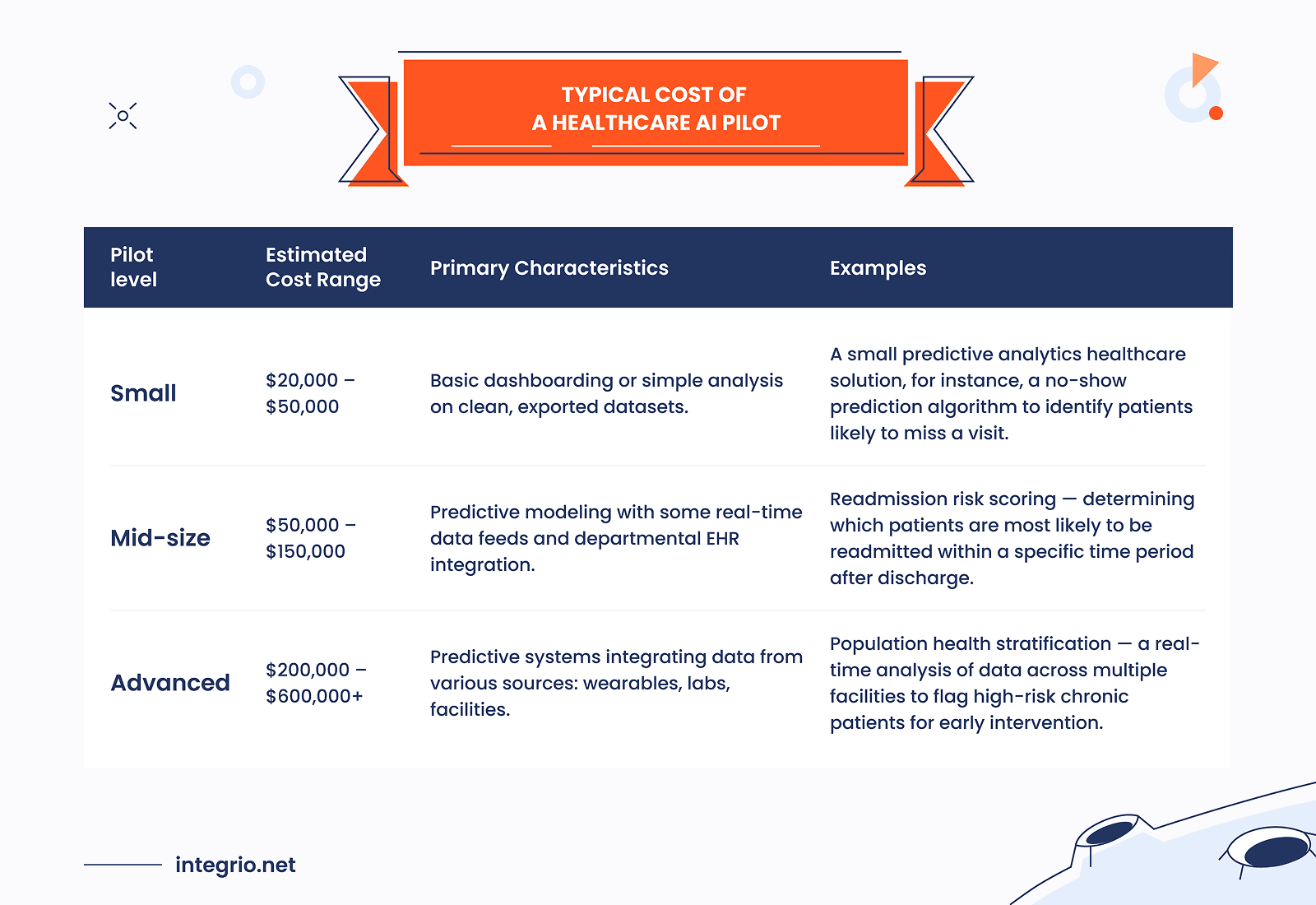
While a pilot is essentially an experiment, its scale and complexity can vary dramatically. That's why healthcare analytics software cost for a trial AI project can be anywhere between $20k and $600k+. To be more specific, we provide cost estimates for three different pilot tiers along with their descriptions and examples.
Why Full Deployment Costs More Than the Pilot
Pilots are launched in small, controlled bubbles. Organization-wide implementation is not just about involving more people. It requires dealing with integrations, infrastructure, and maintenance. All that translates into higher AI healthcare deployment cost, which can amount to $500,000-$1+ million for a mid-sized facility.
EHR/EMR Integrations
Unlike pilots that often rely on static datasets, full deployment requires real-time data synchronization with EHR systems. What's more, data from different hospital platforms may come in different formats, demanding rigorous data engineering.
HIPAA and Compliance Requirements
You can't move beyond a prototype without extensive legal reviews and regulatory documentation. The cost of those alone may amount to tens or even hundreds of thousands. Full-scale HIPAA AI analytics requires real-time PII masking, comprehensive audit logs, and risk assessments, adding to the complexity and cost.
Security Infrastructure
Scaling AI tools requires sophisticated security beyond standard IT, as they deal with Protected Health Information (PHI). Zero-trust architectures, AI-specific firewalls, and encrypted data pipelines are must-haves.
User Training
While AI analytics makes data processing easier, it comes with new human-related challenges. The staff should understand how a model reaches a conclusion, learn to validate its output, and not to over-rely on it.
Monitoring and Maintenance
AI is not a launch-it-and-forget-it kind of tool. Models' accuracy can shift as patient demographics or clinical practices change. Implementing continuous performance tracking and fine-tuning algorithms when they go adrift adds up to the budget.
Scaling Across Departments
Covering more departments may require unique module integrations. In some cases, clinical workflows need redesign to accommodate new tools. Productivity drops initially, resulting in hidden deployment cost.
Main Cost Drivers
Artificial intelligence algorithms require a solid foundation to succeed, which entails some complex and resource-intensive solutions. Let's examine the key factors that push the AI in healthcare pricing up.
Data Cleanup
AI analytics is only as good as the data it is based on. Data cleaning, labeling, and normalization can consume more than half of the total implementation budget. Configuring ETL (Extract, Transform, Load) processes to map complex, messy clinical data into a format the AI can understand requires substantial effort.
Legacy Systems Integration
If a healthcare organization uses legacy platforms that lack modern APIs, it will need custom-built middleware or connections for new AI tools to work. In extreme cases, it may require an infrastructure overhaul to keep pace with current data processing demands.
Custom Dashboards
Building specialized clinical dashboards can require multiple interactions to fit into routine workflows and avoid making "just another screen." Depending on the project, healthcare apps may need to serve diverse users, which complicates the UX requirements and demands more skill and effort from the development team.
MLOps and Retraining Pipelines
We've already mentioned that AI requires more than a one-time "build" expense. To protect it from decay, you'll need a model-drift detection system, an automated retraining infrastructure, and MLOps engineers with specialized healthcare knowledge. Retraining and model improvement can account for 15-35% of the total cost over the system's lifecycle.
Change Management
Aside from technical hurdles, implementing artificial intelligence poses adaptation challenges, which are often overlooked. Redesigning and optimizing workflows, training, managing resistance, and engaging stakeholders - all that requires time, effort, and money. Change management cost may amount to 10% to 25% of the implementation budget.
Timeline from Pilot to Deployment
We've described what it costs to build a custom healthcare analytics platform. Now let's examine how much time it will take. The whole process can be divided into three phases:
01.Pilot
Duration: 4-10 weeks
This is a "sandbox" stage to prove technical and clinical feasibility. The team teaches AI to read the hospital's data and runs it against known outcomes to check for accuracy and bias. Also, they experiment to determine the best place in the clinical workflow for the new tool. The goal is to get a measurable result that justifies moving forward.
02.Controlled Rollout
Duration: 2-4 months
The AI begins processing real-time patient data. A team of doctors and/or nurses uses it and provides feedback, the dev team makes adjustments. Training sessions begin, the protocols are established to determine what happens when a human disagrees with AI.
03.Enterprise Deployment
Duration: 6-12 months
The new system is starting to handle the data load for an entire hospital. The AI becomes a part of the clinical workflows. Continuous monitoring is established to ensure the model doesn't lose accuracy over time. The organization compares the costs incurred against the outcomes to calculate ROI.
Where Integrio Systems Helps
If you are looking for a healthcare AI development company, consider Integrio. After 25+ years in custom software development and more than 200 completed projects, we've accumulated substantial experience in many areas, including artificial intelligence. Our team of data scientists with PhDs in Math and Computer Science will cover the entire AI integration process, from data analysis and preparation to integration and post-launch support. Particularly, we can help you with:
- AI analytics architecture
- Healthcare integrations
- Dashboards and forecasting
- Scaling pilot projects into production
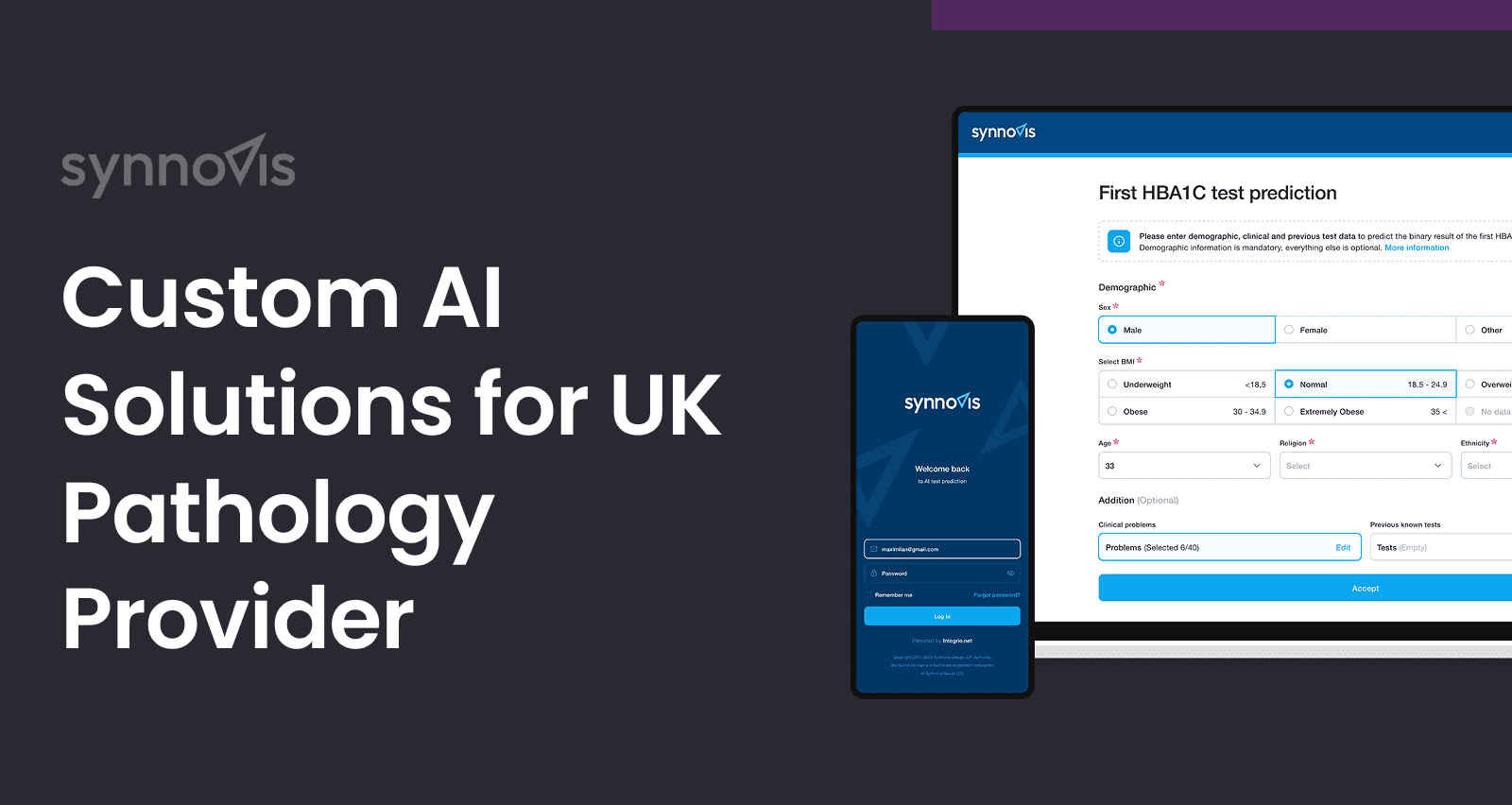
We have hands-on experience implementing AI for healthcare organizations. For instance, we designed AI-driven test optimization solutions for Synnovis, a leading pathology provider for the UK's NHS. Those tools help to identify unnecessary, duplicate, and missing tests and provide evidence-based test-ordering advice. Also, our algorithms forecast patient pathology test needs and predict high-risk conditions by analyzing symptoms and test results.
Conclusion
Healthcare AI analytics cost may vary from tens of thousands of dollars for a pilot to a couple of million for a full-scale implementation. The estimated project duration spans from several weeks for a trial to a year for enterprise deployment. Wondering about the AI implementation budget size and timeframe for your particular case? Contact our experts and get a tailored estimate.
FAQ
Healthcare AI pilot costs may range from $20k to $600k and more, depending on the project's complexity. The full-scale deployment budget is typically higher. For a mid-sized facility, it may amount to around $500,000-$1+ million.
The pilot may take from four to ten weeks. It is followed by a controlled rollout, which requires two-four months on top of that. The final phase, enterprise deployment, typically takes from half a year to one year.
Healthcare AI analytics cost may range from several dozen thousand dollars for a trial project to several million dollars for a full-scale implementation. However, bear in mind that ongoing costs, such as model retraining, monitoring, and maintenance, can account for an additional 10-25% of the initial build cost over the system's lifecycle.
The exact answer depends on the use case. The core foundation of healthcare AI is clinical data: Electronic Health Records, clinical notes, lab and test results, medical images, genomic data, etc. A custom healthcare analytics platform for streamlining hospital workflows and managing costs may analyze operational and financial data. That includes insurance claims and pharmacy data, administrative records, and supply chain data, such as inventory levels and equipment usage metrics.
Most off-the-shelf AI solutions target mid- or enterprise-size organizations, as ML models require large patient populations and clean, structured data pipelines. Besides, the pricing is quite steep. The realistic options for small clinics include EHR platforms with AI features, standalone AI scribes with limited analytics, revenue cycle AI solutions, and free population health AI.
Contact us
