
How AI is Changing the Landscape of Canadian Agriculture


People outside the agricultural sector may still hold outdated views of the industry, imagining farmers doing chores by hand and shunning technology. This is, of course, a far cry from the reality of agriculture in Canada – a bustling industry full of successful businesses. However, if there’s one facet of modern tech that it hasn’t fully embraced, it’s AI.
Resistance to change, especially one as transformative as AI solutions, is understandable in an industry with such a long history. However, we firmly believe that adopting AI in agriculture can be a game-changer, helping companies increase profits, reduce risks, and grow their operations. So, today’s article will talk about how to achieve all that and why AI is such a vital tool, not something to be afraid of.
Integrio Systems has already highlighted the thriving AI ecosystem in Canada, replete with expert consultants, conferences, and government-funded programs. Now, we will look more deeply into the agricultural use of AI, highlighting its strengths, challenges, and promises. Our article will also include some real-world examples to illustrate that this tech isn’t just untapped potential.
Thanks to our 25+ years of work in the Canadian market, we not only have tech expertise but an understanding of regional preferences and ongoing trends. This positions us as true experts who can not only develop a custom solution for you but also advise you on your business roadmap. In short, you’re in good hands, and we can start our guide to the intersection of AI and agriculture.
The Current State of Agriculture in Canada
It wouldn’t be an exaggeration to call Canada’s agriculture a vital part of its economy, both in the revenue it provides and the jobs it creates. Stats for 2024 show that 1 in 9 Canadians are working in the agri sector, and it generated a whopping $149.2 billion that year. This data reflects just how sprawling the industry is, with some agricultural jobs present even in Yukon.
The bad news is that, even as it adopts technological advances, the Canadian agricultural industry does not keep up with other nations in that regard. That, coupled with an aging workforce and the hard labor associated with the sector, could snowball into a major problem. While not all of the issues plaguing the industry can be remedied through tech, this one is certainly solvable through the adoption of modern, reliable solutions.
AI just so happens to be the currently relevant branch of tech and shouldn’t be treated as an external force seeking to disrupt the industry. Rather, it’s simply a tool, just like regular IoT devices and automation, which have become quite standard for agri-corporations. What AI can do, specifically, is nurture growth through process optimization and secure businesses with smart automation.
Those hesitant about adopting AI can simply look at how previous innovations in tech have changed the field, such as automation being quite widely adopted among larger agribusinesses. Plus, data engineers and analysts are using refined models to predict droughts, schedule planting, and plan large irrigation systems. Infusing AI into their work will only improve it.
Lastly, perhaps the biggest advance that ensures agriculture’s lasting legacy is the application of genetic engineering. Using modern tech, scientists are creating resilient subspecies of familiar crops, preventing diseases in them, and making farming easier. This, too, can be amplified with AI farming solutions.
Moreover, our guide will help make your decisions about AI through a comprehensive overview of its advantages and downsides. Right now, we’re ready to start talking about the pros of AI adoption.
Benefits of AI in Agriculture
Before we list all the good things AI can deliver to a business that embraces this tech, we want to make one thing clear. As with almost any change you make, it has to be well-planned, implemented with care, and overseen by professionals. Our advice is not to just see this as a checklist of things you can get easily. Rather, think of which of these are crucial to you and then relay that to your development team.
Accurate Forecasts
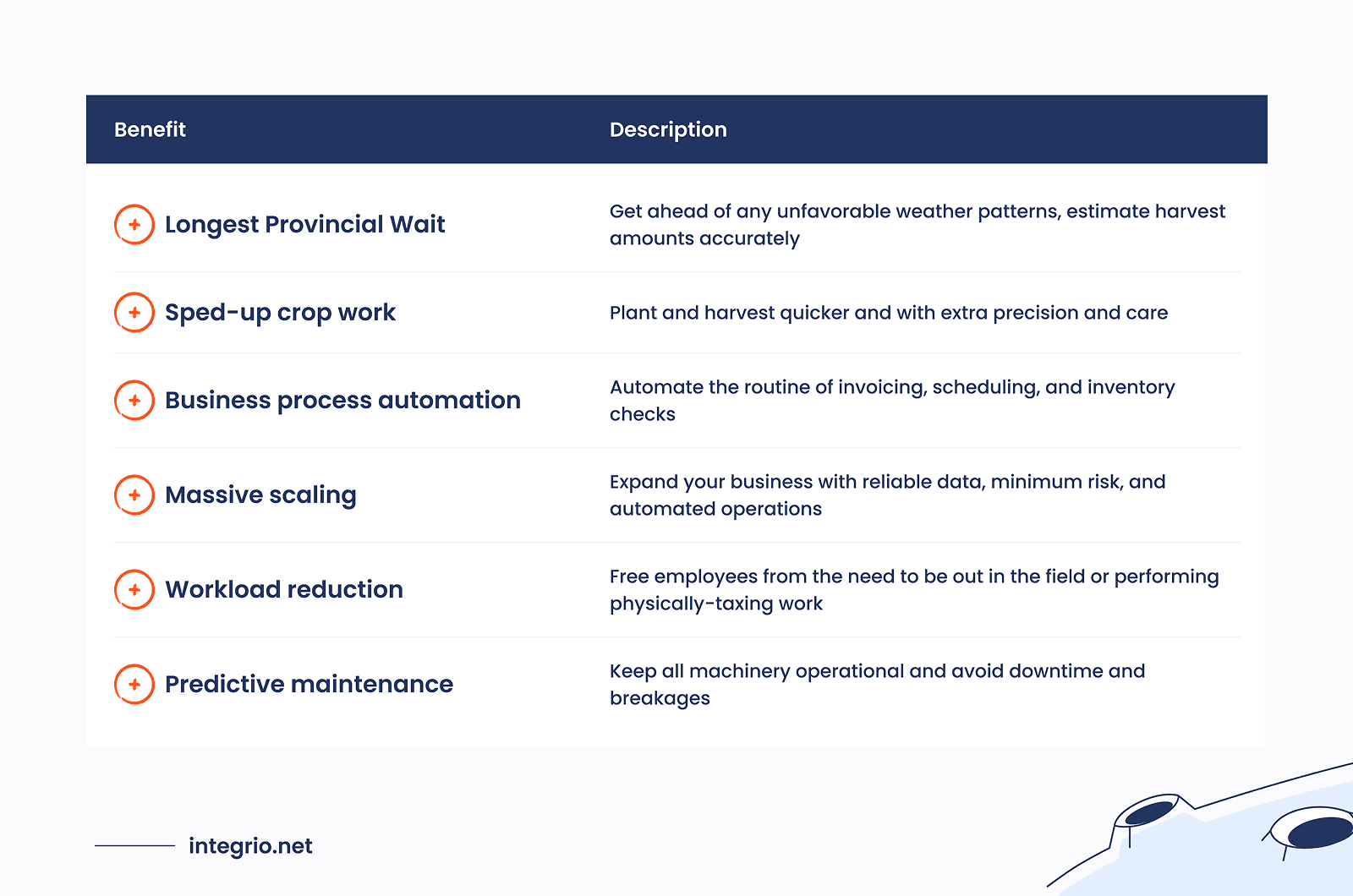
Being able to know exactly how plentiful or sparse a harvest will be can be crucial in setting an agricultural enterprise’s operational plan for the year. It forewarns businesses of potential struggles or the ability to sell more stock than usual. Similarly, predicting weather events can help manage the situation if drought or heavy rain occurs.
Using weather and crop data sourced from your own operations and open sources, you can fine-tune the analytical insights to minimize the chance of wrong information. Harness these agriculture technology insights to ensure that, no matter the conditions, your work is uninterrupted and smooth.
Sped-Up Crop Work
Using analytics to find ideal planting spots and patterns, AI can then automate the process, efficiently planting seeds with pinpoint precision. This does, of course, require special smart devices for AI to control. The gathering part of the crop work can also be sped up without increasing damage to the plants.
Business Process Automation
Agricultural businesses are far from some modest farms where accounting is done in a little notebook and clients just drive up to a fruit stand. This means AI can also help tackle the more typical business processes for these companies, such as reporting transactions and inventory, sending out invoices, controlling logistics with delivery scheduling, etc.
Massive Scaling
Expanding an agribusiness does require extra land and resources, but AI in agriculture can still be helpful in this direction. While it can’t bring you more people and planting area, it can analyze the risks and possibilities of growth, and help expand device networks with automatic programming. Basically, on the technical side, AI is invaluable for scaling.
Stress and Risk Reduction for Employees
A large number of jobs in the agricultural industry are either dangerous or taxing, making them prime targets for AI automation. Humans can rely on specialized machines to plant and harvest crops, move harvested bales, and generally shoulder the physical strain. Cutting into the hours that employees have to spend outside in the blazing sun or working in precarious conditions will hopefully make the industry more attractive to the workforce.
Predictive Maintenance
Machinery used for agricultural purposes requires substantial upkeep efforts, and, ideally, maintenance should be done before it’s actually needed. Predicting the optimal times to take some of your equipment “offline” and work on it is easy with AI analytics. They will indicate which devices need to have work done, when they can be replaced temporarily, and what the cost will be.
Potential Challenges and Risks of AI Integration
A fair overview of AI in agriculture has to include not just its positives but the possible negatives that could come out if integration isn’t handled properly or best practices aren’t followed.
Data Leaks
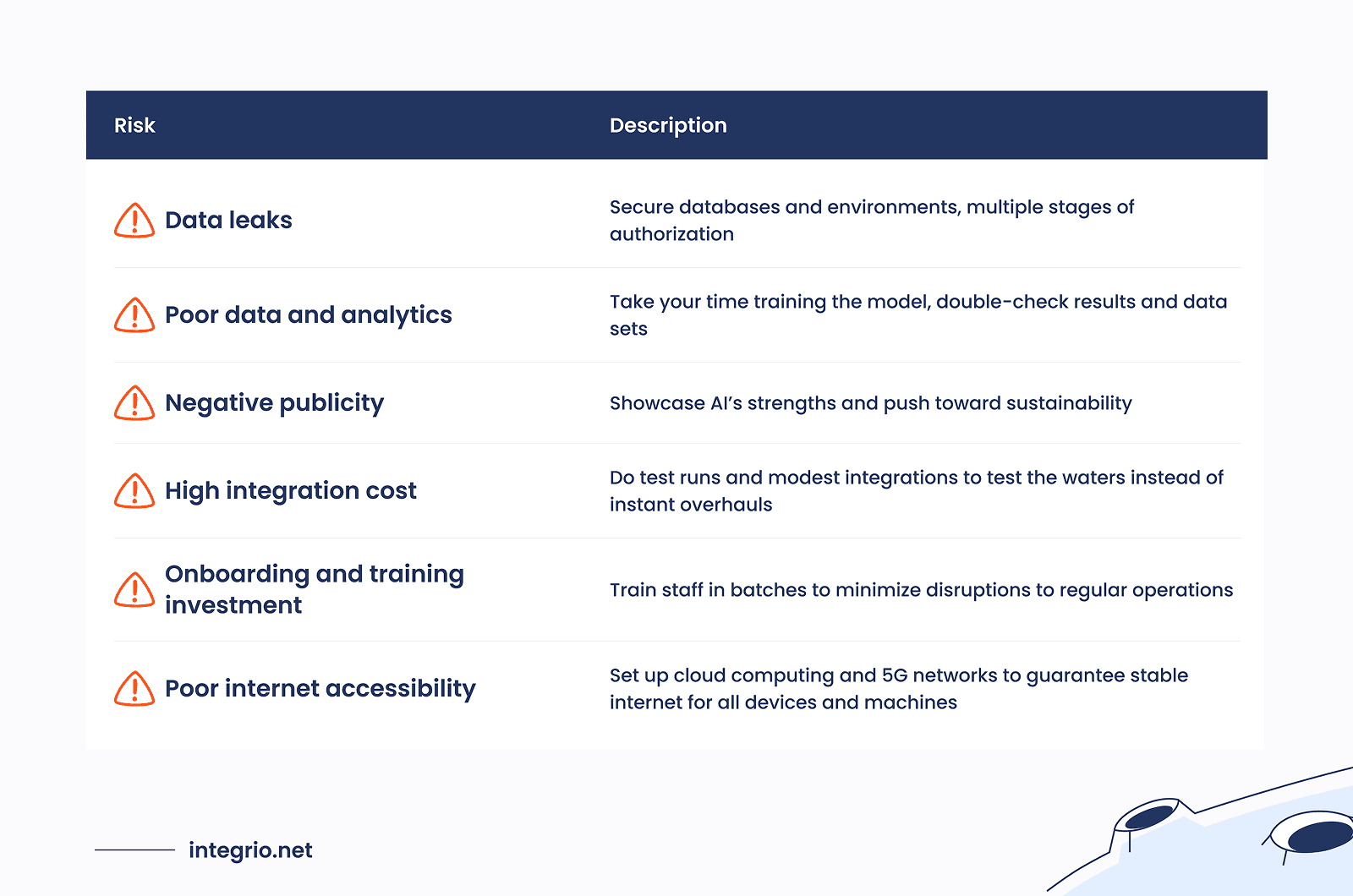
AI models depend on massive datasets for training and can’t deliver half-decent results without them. However, should a company fail to secure its databases and models, a data leak could compromise their reputation and put clients at risk. This can be avoided by following standard practices like encryption and multi-level authorization.
Poor Data and Poor Analytics
Rushing to launch a model without taking proper care to train it with multiple comprehensive data sets is most likely going to result in subpar performance and disappointment. Similarly, not configuring your software when running analytics may end up giving you erroneous results. Pay attention to details and consider context, running multiple tries and monitoring the outcome.
Negative Publicity
Despite the fact that AI is even being used to boost farming sustainability, there is still a stigma attached to it in some markets. Thus, you may have to assess your regular customers’ attitude toward AI and provide information on why you’ve chosen the tech. Luckily, though, the stigma is dying away, and the quality that AI provides helps alleviate it.
High Cost of System Overhaul
One of the reasons we advise taking things slow with AI is that actually overhauling your entire setup to integrate this tech in every aspect of your operations is expensive. You’ll eventually recoup the cost thanks to the optimization, provided you have a good team handling the transition. But, still, most companies would be better off doing test runs, both for quality and cost-saving.
Onboarding and Training Time and Cost
In addition to the general cost of systemic changes, take into account that your employees will need to learn how to master the new system. This will require time and money, potentially slowing down operations somewhat. The best way to deal with this is to plan the first integration for the off-season and ensure that staff can be trained on a rotating basis. With that, you’ll always have the workforce available while part of them are getting onboarded.
Low Internet Quality in Rural Areas
This is already being addressed through cloud computing and the spread of 5G networks, but it remains a problem for those based outside major cities. Spotty internet connectivity could mean that even basic systems get disrupted. But, realistically, a temporary software stoppage is nothing compared to a fleet of AI machinery going offline and having to be reconfigured in the middle of harvesting.
Real Cases of AI Application in Agriculture
To highlight how AI truly impacts agricultural businesses, let’s take a look at some genuine use cases and solutions from companies around the world.
Crop Control
The RoboCare tool uses AI to optimize plant watering, detect diseases in their earliest stages, and inform soil-related decisions. As a result, agricultural businesses can ensure their harvests are healthier and more plentiful.
Weather Analytics
Cordulus is an entire service dedicated specifically to agricultural weather predictions to ensure that farmers can understand how well their harvest will turn out and what the chances of drought are.
Reducing Overhead Costs
BASF, a massive German enterprise, has released agricultural AI tools to optimize resource use, with some companies citing a 90% increase in optimization. This directly reduces operational expenses, enabling sectoral growth.
Canadian Legislation Concerning AI Use
The Canadian government, both federal and regional, is constantly introducing new legislation to regulate modern tech, including AI in agriculture. While 2025’s proposed C-27 bill has been rejected, other frameworks are still in play.
It’s important to understand that not all AI laws are particularly relevant to agribusinesses, such as Quebec’s Law 25. It stipulates that companies must let customers know when their decision-making is fully automated. But, realistically, this applies more to commerce and consulting firms. On the flipside, Alberta’s AI guidelines emphasize explainability and risk assessment for AI use, meaning you have to show data proving your AI use is safe and legal.
There’s also the 2023 Generative AI Code of Conduct, which may apply to some of your future use cases. That one, however, is voluntary for now, though we wouldn’t be surprised to see elements of it elevated to the legal framework on some level.
If you’d like more information on province-specific legislation or specific AI use cases, let us know, and our experts can consult you on the current laws and ways to proceed.
How to Integrate AI in an Agricultural Business
Now that we’ve gone through all the ups and downs of AI agriculture applications and highlighted their real-world uses, let’s talk about how to enhance your ecosystem with AI.
01.Research and Assess
First things first, run an assessment of your ecosystem and identify parts of it that could be optimized to use fewer resources, take less time, or provide a greater overall benefit. These will be your targets for AI enhancement. Next, find a vendor that offers AI solutions and discuss the options available on the market and whether they meet your needs.
A reliable development partner should have years of experience and a strong presence in the Canadian market. Couple that with solid portfolios, and you can be sure that you’ll get the best advice and product. Here’s how the conversation with them may go:
- Provide a list of points that your AI should cover;
- Vendor compiles a list of available tools;
- Estimate whether these will match you 100%;
- If you find market offerings lacking, request a custom solution.
02.Request and Test
Once you’ve made your choice, be it an off-the-shelf piece of software or a custom one, we recommend doing a test run. For a market solution, this just means getting a trial and seeing how it performs. Analyze how your business stats change, whether workload lessens or processes speed up. Basically, see if the software does what it’s supposed to.
For custom solutions, request an MVP or a small integration and look for the same things, just on a slightly different time scale. Crafting a fully customized solution that fits your ecosystem takes a bit longer than just buying a random piece of software, after all. The goal, however, is the same in both cases—ensure that it’s worth moving forward with the product. Price-wise and performance-wise, of course.
03.Analyze and Scale
Having done your trials and tests, estimate how the results can be improved, but be realistic. A mass-market solution has only so much flexibility, and a custom one requires serious investment for any new functionality. So do a cost-value assessment to see which parts are worth scaling and how big of an improvement AI can offer to your ecosystem.
We do recommend consulting with your vendor on this, too, as they might be able to find shortcuts or ways to maximize efficiency with minimal spending. Obviously, a good team won’t promise you miracles, but decent savings or all-new features are quite possible with proper planning.
Future Trends in Agricultural AI Use
The current generation of AI in agriculture is already invaluable, but, truthfully, AI is still in its infancy. There is plenty of space for it to evolve and morph to have new applications and possibilities. While we can’t predict all of them, mainly because this technology is changing rapidly and many companies are working on it, we can identify some trends. This section will cover AI directions that can already be identified and will be well-suited for agriculture.
One key improvement will be in accuracy and precision, as AI models will be able to detect the tiniest signs of disease in plants and use a multimodal approach. The latter means analyzing text, images, and sensor data all at once to get results. This can help systems understand their findings in context and provide better results.
Plentiful investments are also driving some growth in the AR/VR crossover space with AI, allowing staff to control AI-supported machinery in the fields. This guarantees they will do exactly what’s needed, with humans being able to take over for any extra-delicate work.
Those who’d prefer to go fully autonomous can get their wish as well, as drone networks will hopefully soon be standard, thanks to refined tech and the spread of cloud computing. This means that even rural areas will have strong enough internet and signal quality to run IoT en masse.
Lastly, IoT usage, such as sensors and control panels, enhanced by AI, will be crucial for indoor growing and cattle control. Agricultural businesses will be able to guarantee their livestock is thriving and secure without even being on-site, dispensing food and allowing them to roam as necessary.
Conclusion
As we reach the end of our coverage of AI in agriculture, it’s essential to take stock of how we talked about it and, hopefully, how you now think about it. Instead of a hyped-up technology that some people promise to be everything, it’s a multifaceted tool with its own ups and downs. We’ve talked about its numerous benefits and the potential risks of integrating it into your business.
However, we do want to stress yet again that all these challenges are surmountable and the rich advantages, from more bountiful harvests to more stable operations, are truly tempting. The agricultural industry is a tough space to navigate, as climate issues, supply chain disruptions, and a dwindling workforce pose obstacles. This means businesses pretty much have to rely on technology to stay afloat.
Integrio Systems has studied the Canadian markets extensively over our 25+ years of work, so we can not only develop your ideas into software but also consult you on the best way forward. Our team prides itself on delivering quality, whether with newer technologies like AI models or classic tools applied in novel ways. By studying your business and listening to your needs, we create a full-fledged plan to help you thrive.
If you’re still left with any questions about AI in agriculture or general queries about how AI can be applied, reach out, and we can navigate these problems. Our experts will guide you to the optimal solution and get you connected to a team that can improve your ecosystem and expand it with new solutions.
FAQ
One key bit of advice we’d give is to start small. Many companies are pushing for disruption and huge transformations, but the ideal approach is to study your own operations. In doing so, you learn what you lack, what could be optimized, and how AI could fill those gaps. Once you have this data, a vendor can help you with a custom solution that tackles some of these small problems.
After a trial run, you can assess how well the solution worked for you and, if needed, tweak it and your use of AI. If the results prove satisfactory and operational data show that AI is worth it, you can expand your use of it by commissioning new software and integrations. This way, you can be certain you’re not just jumping on a trend but applying a worthwhile tool to your business.
Pretty much every single benefit and trend we’ve mentioned above is relevant for other markets as well. An overview of EU agriculture shows that robotics and AI are already delivering benefits, including precise analytics, yield control, soil health studies, and more. What’s important here is that this experience from abroad can be applied to our own needs.
Integrio Systems puts the Canadian market first, but having worked with companies from all over the world, we see which tools prove to be most effective. Thus, if you want to make sure you’re using time-tested solutions, we can consult you on what the overseas agri-companies are doing with AI.
With the growth of AI in agriculture, there are certainly high-quality offerings on the market that can be purchased outright. However, custom products may be a bit more expensive and take some time to develop, but they have the significant advantage of being tailor-made for a company. This means they will be designed to solve your specific problems and be compatible with your ecosystem.
Combine that with the fact that a custom solution guarantees the security of your operational data and the ability to pivot easily and add new features, and the choice gets even trickier. If you have a reliable vendor, such as Integrio Systems, a custom AI product may end up more budget-friendly and is most certainly going to accomplish more for you.
While AI can automate certain processes and remove the need for people to do all the work manually, it doesn’t replace human employees. For one, there are plenty of things that it just won’t be able to do, at least in its current state. This may include more delicate and precise work on plants, for example.
Then, there’s the fact that the AI itself needs monitoring, meaning people will simply move from handling the processes directly to overseeing them. This lowers their workload while still keeping them relevant. At the end of the day, it just lets people avoid the more straining and dangerous tasks.
Contact us
