Payment systems seem easy to design only until real money enters the picture.
The build-vs-buy question for a payment processing system is rarely about the technology. It’s about whether you can afford the compliance overhead, specialized talent, and time it takes for iteration to reach production-grade reliability. Here’s how to calculate that honestly—and what it really costs to go from prototype to full deployment.
What Starts Breaking When Payments Go Live
When a payment system leaves a development environment, it no longer operates under the controlled conditions for which it was built. Real usage introduces retries, delays, and inconsistent responses. There are several points where things typically start to break:
The page doesn’t respond immediately. Users repeat payments, resulting in duplicate transactions and chargebacks.
Confirmation does not arrive in time. Payments go through, but the system takes extra time to notice and responds with an error message.
Internal records do not match provider or bank data. Reconciliation failures tend to cumulate and turn into a nightmare if processed manually.
Refund status doesn’t update correctly. The refund goes through on the processor’s side, with the status freezing on “pending.”
The order or service is not activated. Customers are charged, but something breaks during the handoff (e.g., a timeout or a failed API call).
All these failures happen to well-built software on competent teams with proper business development skills. They’re caused by the gap between how payment infrastructure behaves in theory and in practice. A prototype handles the happy path, but a production system often faces variables that simply don’t exist in the development and test environments.
What a Payment Prototype Usually Includes
Before a payment processing system can handle production complexity, it starts with something much simpler: a prototype. Understanding what it includes and what it deliberately leaves out is the key to budgeting for what comes next.
Basic Setup
A typical prototype is built around an established payment provider—Stripe, Adyen, Braintree, etc. It’s easier to architect this way. The setup usually covers:
A hosted checkout page supplied by the provider instead of a custom UI.
A lightweight backend for initiating payment sessions.
The provider’s own dashboard for monitoring and managing transactions.
For a proof of concept or early beta, it works well. A provider covers security and compliance, card network rules, and fraud screening. You build only what’s required to connect your product to that infrastructure.
What Is Still Missing
A prototype works precisely because it avoids complexity. Everything predictable runs fine. The problems emerge when something unexpected happens, and there’s no internal logic to handle it. At the prototype stage, that logic is almost entirely delegated to the provider.
To name a few things that are typically absent:
Internal transaction records that exist independently of the provider. If Stripe’s data and your database ever diverge, there’s no source of truth to fall back on.
Retry and timeout handling built into your own system. Delayed confirmations either error out or get ignored rather than being queued and resolved.
Reconciliation tooling for verifying data. It’s impossible to match your internal records against provider data and bank statements on a rolling basis.
Observability into failed or ambiguous transactions. The prototype surfaces clean successes and clean failures; the edge cases in between are largely invisible.
Operational independence from the provider. The team has limited ability to investigate or intervene in any accidents.
These are deliberate trade-offs that make early delivery possible, but all need to be addressed later.
Typical MVP Cost
If we speak about IT project outsourcing, the payment processing system cost is between $40,000 and $60,000, covering:
Provider integration (the payment processing engine itself).
Basic backend (with payment session and webhook handling).
Functional UI (with hosted or lightly customized checkout components).
The lower price tag—basically the payment system integration cost—is a direct result of leaning on the provider for the core part (PCI compliance, card network connectivity, and baseline fraud screening). Delivery is faster for the same reason, taking six to twelve weeks.
What Changes in Production Systems
A prototype is built to demonstrate that payments can work. A production system is built to ensure they work correctly—every time, under conditions that aren’t predictable, for users who won’t wait and won’t forgive errors. That distinction affects several aspects of payment system design in subsequent stages.
Transaction Control and Reliability
In a live environment, there is no acceptable margin for ambiguity. A transaction either succeeded, failed, or is in a known intermediate state with a defined resolution path. Everything else is a problem—hovering over the team constantly if the underlying production infrastructure isn’t built to handle various use cases.
Duplicate charges are the most visible failure. A user submits a payment. The response is slow, so they submit again, and both go through. Unclear transaction states are another risk. A payment authorizes, but the confirmation webhook arrives late. Your system has no record of success, but the bank does.
Production reliability means the system handles retries, timeouts, and out-of-order events without duplicate charges, unclear transactions, or anything similar. That logic doesn’t exist in a prototype.
Data, Reconciliation, and Visibility
When a business relies entirely on a payment provider as its source of truth, any discrepancy between the provider’s and internal records becomes difficult to investigate and slow to resolve.
At low transaction volumes, this is manageable. As volume grows, the gaps accumulate, and the diversity of issues increases. You risk experiencing currency rounding differences, refunds logged against incorrect transaction IDs, timing mismatches between webhook events and database writes, and more.
A production system should maintain its own structured transaction log—independent of the provider, updated in real time, and complete enough to reconstruct the state of any transaction from first attempt to final resolution. That payment transaction database design is what makes financial reporting reliable, audits manageable, and dispute resolution fast.
Security, Risk, and Operations
Security in a payment system is a structural property that must be present from the outset. Fitting compliance into an existing system costs more and takes longer than building it correctly the first time. Also, scope management, tokenization, access controls, and audit logging affect the payment system architecture.
The same is true for fraud management. Providers offer baseline screening, but production systems need additional tooling that must evolve along with the fraud patterns: velocity checks, device fingerprinting, behavioral signals, and specific rules. Finally, there’s monitoring: production operations require real-time responses for all transactions 24/7.
Cost Breakdown: From MVP to Production
The jump from prototype to production isn’t a linear increase. The payment infrastructure cost curve bends sharply for a reason. At the MVP stage, you’re building a connection. At the production stage, you’re building a system that has to be correct, resilient, and auditable under conditions you don’t control. To break it down quickly:
MVP: $40k–$60k. As covered in the previous section, this budget buys a working integration with intentionally limited but functionally sound scope. Think of it as renting infrastructure rather than owning it.
Production: $150k–$300k+. A production payment system requires a custom transaction layer, more complex logic, reconciliation infrastructure, native tooling, and more. This is where the real engineering investment begins.
Infrastructure and compliance. Rarely show up clearly in early estimates, but always increase costs via hosting, database configurations, monitoring and alerting, and specific certification requirements.
Ongoing maintenance. Becomes a long-term expense. It amounts to around 15–25% of the original build cost annually, covering updates, API usage, incident response, performance tuning, and the steady stream of edge cases.
A payment system is closer to a product line than a finished feature. Building one is just the beginning, not the finish line.
Build vs Buy Your Own Payment System?
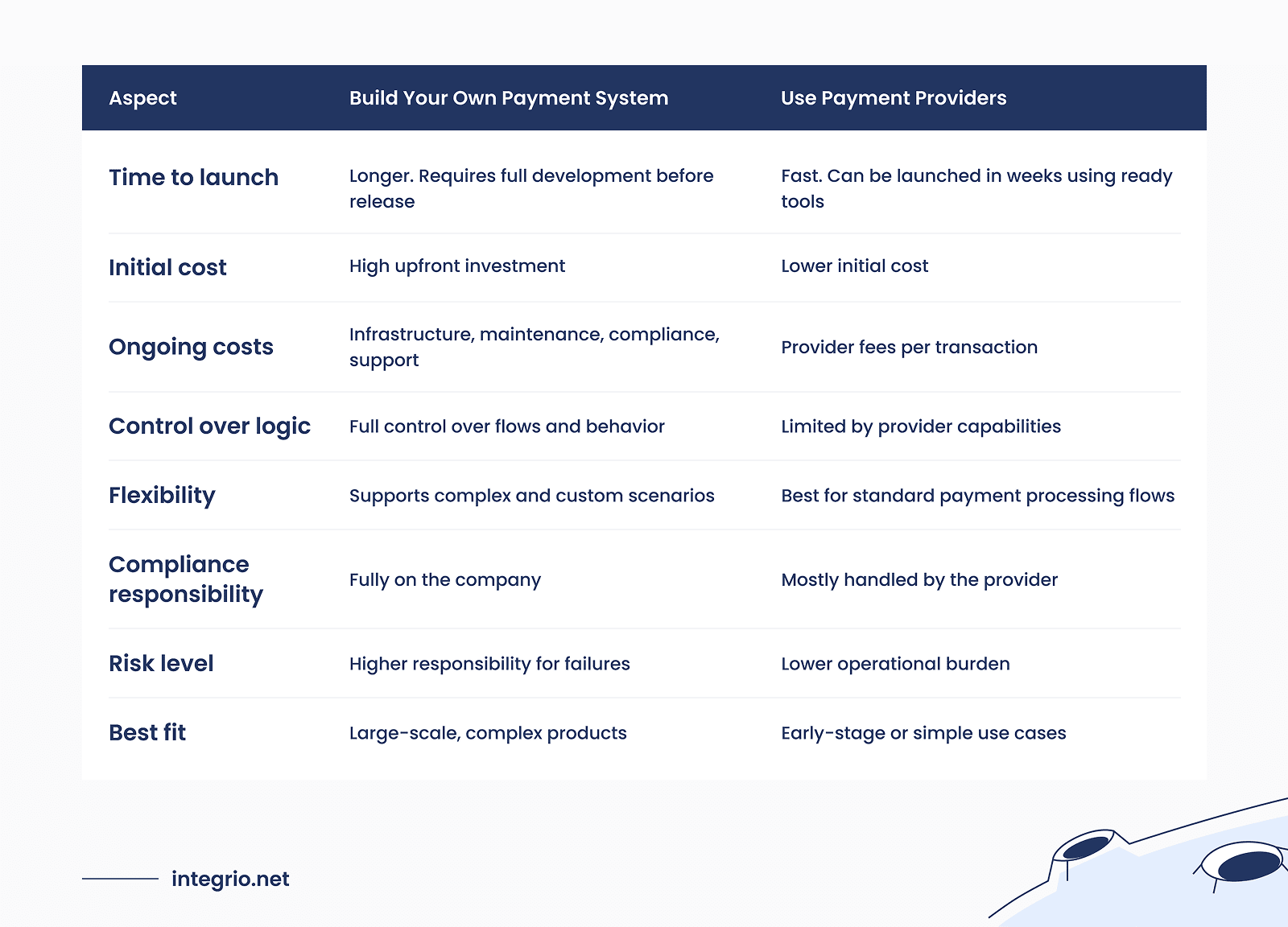
There’s no universal answer here. The build-vs-buy decision comes down to whether your current setup is actually limiting the business.
When Building Makes Sense
Companies move toward building their own payment infrastructure when third-party providers start creating real friction, concrete problems showing up in the product or on the balance sheet.
The clearest trigger is volume—when transaction fees eat up a significant share of revenue. Another case is outgrowing an off-the-shelf solution. Some products eventually require payment flows that standard integrations weren’t designed for. A custom payment system for marketplaces with split payouts or a payment system for SaaS with complex subscription logic is usually worth investing in.
It makes sense to build a payment system if it promises to directly improve margins, operational control, or product capability, and if the team has the capacity to take on the associated costs.
When It Does Not
In most cases, especially early on, building a payment system adds significant complexity without creating meaningful value. The more honest question isn’t whether you could build it, but whether it would improve the operations.
If a product is still finding its shape and payment flows can change, custom payment system development makes little sense. The same applies to cases with low transaction volumes, basic subscriptions, and simple payment logic. Designing something as complex as payment software is a waste of budget.
If providers already solve the problem well, building your own system usually slows the product down rather than improving it.
Conclusion
The prototype was never the problem. It did exactly what prototypes are supposed to do—prove the concept, impress the stakeholders, get the green light. Production payment infrastructure is a different category of work. It requires expertise in compliance, fraud experience, and engineering depth. The payment system cost entails not just money but also time, focus, and opportunity.
If you’re planning a payment build and want to get ahead of the failure modes, talk to a team that has shipped payment systems before—a team like ours. Reach out to discuss the realistic scope, budget, and challenges before making any serious development steps.
FAQ
It’s the infrastructure that moves money from a customer’s account to yours. It includes a chain of components that activate in a sequence—a payment gateway, a processor, the issuing bank, and the acquiring bank. Each has its own rules, fees, and failure conditions.
Test environments tend to accept any card, ignore fraud signals, and skip compliance checks. Even if they don’t, the test cases and test data used simply cannot replicate all possible real scenarios. Real transactions involve live banking rails, regulatory obligations, currency handling, and reconciliation logic that has to be accurate to the cent.
It rarely happens because of the core payment logic. More often, failures are caused by the surrounding infrastructure webhooks that miss confirmation events, duplicate charge bugs triggered by network timeouts, or fraud patterns the system wasn’t built to catch.
Yes, and it makes sense when payments are genuinely core to your product, or you’re dealing with large transaction volumes. Just make sure to start with the payment system vs payment gateway difference to tell for sure which one you need.
The standard model is a percentage plus a flat fee per transaction. For example, Stripe and PayPal both charge around 2.9% + $0.30 for card payments, with enterprise pricing significantly lower thanks to operational volume. Additionally, there are monthly chargeback fees and currency conversion handling.
We use cookies and other tracking technologies to improve your browsing experience on our website. By browsing our website, you consent to our use of cookies and other tracking technologies.