
The Product Discovery Phase: Why It’s the Most Critical Step for ROI


In 2020, Quibi, a short-form streaming platform, raised around $1.75 bln in funding. The pedigree of its founders, veteran business leaders, and the innovative "Hollywood on Your Phone" idea appealed to investors. However, despite a promising start, Quibi was shut down by the end of the year. While the pandemic contributed to its demise, the key reason is believed to be the failure to find a market.
Thus, in 2026, Quibi remains a vivid reminder: even high investment and star power cannot replace validation of product-market fit. That’s why a rigorous product discovery process is crucial for any team working on a new digital solution. In this blog, we’ll describe what product discovery is, how it influences the ROI, and how to conduct it.
What Is Product Discovery?
Product discovery is the stage before development in which a team determines what to build, for whom, and why. That involves:
- ensuring the idea is market-worthy: assessing demand, revenue potential, competitive advantage, retention, or cost reduction.
- identifying the right problem to solve, testing assumptions.
- understanding user needs, pain points, behaviors, and context.
Common product discovery techniques include user interviews, customer journey mapping, competitor analysis, opportunity scoring, brainstorming and ideation workshops, rapid prototyping, usability testing, and A/B testing or experiments.
Discovery vs. Delivery
In practice, the boundaries between discovery and delivery may blur, but they should not be confused. Each requires answers to a different set of questions:
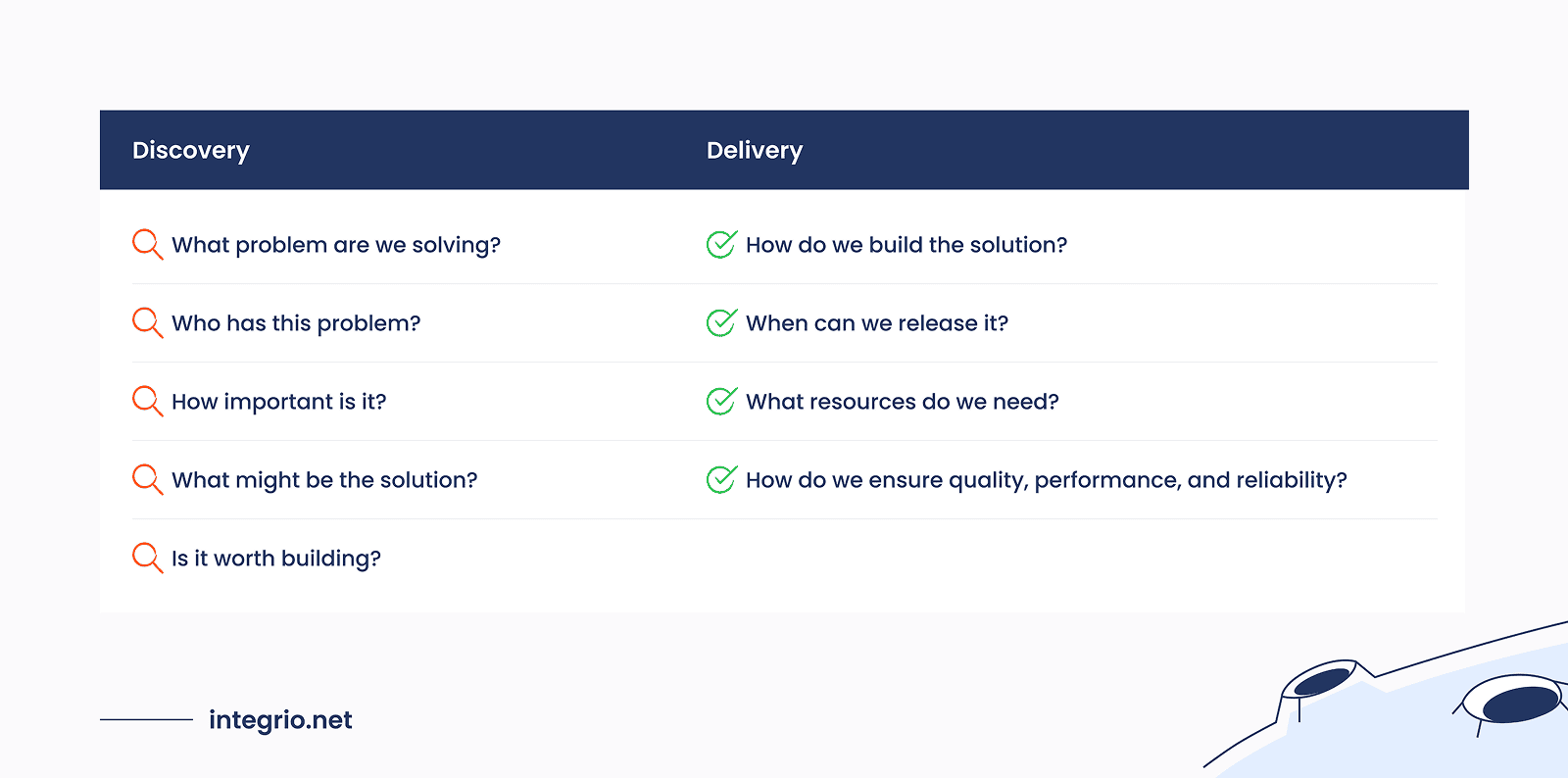
Where does the discovery fit in the product lifecycle
Product discovery usually happens before the delivery, but it isn’t just a kickoff step. The teams explore the problem, users, constraints, and possible solutions to decide what to build. After the launch, they may still return to discovery to improve or expand the product. For solutions that have been around for a while, discovery may also precede product modernization.
Why Product Discovery Determines ROI
Discovery directly impacts ROI in product development, ensuring that what you build solves a meaningful problem:
- Reducing wasted development costs. Building the wrong thing consumes budget, team capacity, and time that could be better used. For example, a team may develop a digital marketing product with many attribution views, automation rules, and reporting layers, only to learn after launch that users would prefer simpler campaign management.
- Improving product-market fit. The value of discovery is not limited to UX improvements. It helps to determine if a problem is real, important, and common enough to solve. Consequently, teams improve their chances of building something the market actually needs.
- Improving the speed of validated decisions. Experienced product teams shift from “building fast” to “building right”. While time-to-market still matters, validating the assumptions first significantly reduces risk. Rather than moving quickly in the wrong direction, teams discard weak options and focus resources on the most promising ones.
- Aligning teams around value. Product discovery gives design, engineering, and business stakeholders a single point of reference for what matters and why. That keeps everyone focused on solutions that create real value.
The Consequences of Skipping Product Discovery
Skipping product discovery, teams rely on their “gut feelings” and risk pursuing the wrong opportunities.
Building something nobody needs
Without proper discovery, you risk pouring resources into something customers do not need, do not adopt, or do not value enough, as the Quibi example shows. Data suggests this is a common mistake: poor product-market fit accounts for 43% of startup failures.
Misaligned priorities
If the stakeholders don’t have a clear idea about the problem, the goal, and the expected outcome, they may move in different directions. As a result, efficiency suffers and the development process stalls.
Increased rework and technical debt
The lack of validation at the start often leads to frequent requirement revisions later. The team has to rebuild parts of the product or implement short-term fixes, leading to the accumulation of technical debt over time.
Delayed ROI and failed launches
A product launched on schedule doesn’t guarantee returns. If the team solved the wrong problem for the wrong people, or did so the wrong way, adoption may suffer. That may delay ROI and increase the risk of launch failure, underlining the business value of product discovery.
The Product Discovery Process: A Step-by-Step Guide
To mitigate risks and improve ROI, the discovery phase should be thoroughly planned. This is the step sequence we’d suggest, based on our experience, to ensure you dot all the i’s and cross all the t’s before the delivery starts.
01.Define the “Why”
The first step is to clarify why the product or feature should exist. The idea may sound interesting, but it has little business value. If the team can’t frame the problem clearly and explain why it matters, it is hard to justify the investment.
02.Define product success metrics
Once the team has picked a business-worthy goal, they need to define what success looks like. That includes outcome signals tied to business value, including revenue impact, retention, adoption, cost reduction, or operational efficiency. Thus, the question shifts from “Is this idea exciting?” to “Can this idea realistically produce measurable returns?”
03.Identify constraints and risks
At this stage, the team lists technical, business, and user risks as well as the assumptions that require validation. This reveals factors that could make the investment fail. A product idea may look strong on paper but be riddled with pitfalls, such as implementation complexity, weak demand, or usability issues.
04.Understand your users
The next step is to find out who the users are and what they need. This is important to determine what would create enough value for them to adopt a solution. Without user research, the team may build something that technically works but fails to attract interest and generate revenue.
05.Prioritize problems to solve
There are multiple user and business problems, and therefore multiple opportunities to take. The team must focus on the tasks with the highest business impact and shape the product investment strategy accordingly.
06.Ideate solutions
Once the problem is clear, the team begins brainstorming approaches and exploring possible solutions. The trick is to choose a smarter path and avoid overbuilding. The solution has to be:
- valuable enough to matter,
- realistic enough to build,
- not so expensive that it hurts ROI.
07.Prototype and test
Next comes rapid prototyping, usability testing, and iteration loops. The goal is to validate demand, usability, and solution fit. Finding and fixing problems with the prototype is far less costly than doing that after launch.
Who Owns Product Discovery?
The product manager leads product discovery, but a single person should not own it. In strong teams, discovery is a shared responsibility. Let’s examine how that works.
Product managers connect user needs, business goals, and product decisions. Their role is to:
- frame the problem,
- define the opportunity,
- align discovery with business value,
- keep the process outcome-focused.
Thus, they ensure the discovery determines whether a problem is worth solving and whether the solution is worth the investment.
However, a product manager can’t do it alone. Discovery is a multi-faceted task, involving different roles:
- Stakeholders assess business context, weigh strategic priorities, and consider operational realities.
- Designers conduct user research, journey mapping, and prototyping, and provide usability insights.
- Developers evaluate technical complexity, feasibility, and risks.
Each role offers a unique perspective on building something that works, sells, and generates revenue. Solid cross-functional collaboration from day one allows teams to make better decisions earlier.
Product Discovery Frameworks: When and Why to Use Them
Product discovery frameworks structure the process of exploring problems and testing ideas. Their goal is not just to make the discovery feel more formal, but to reduce waste and improve the chances of getting real business value.
Here are four commonly used frameworks and approaches to product discovery.
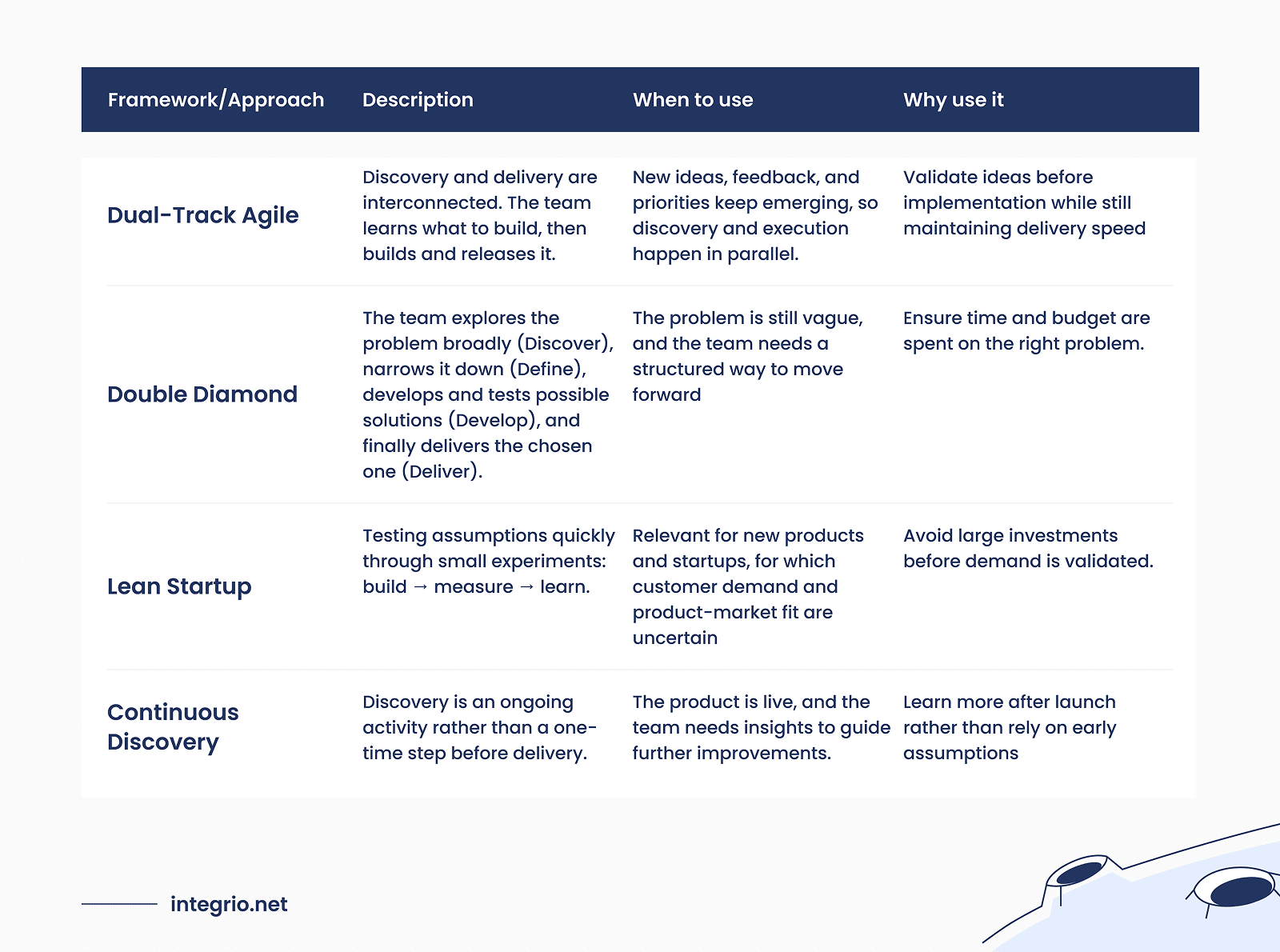
Conclusion
The product discovery process should not be treated as an afterthought or a formality. It directly influences ROI by ensuring product-market fit. Rather than wasting valuable time, it allows teams to move forward with validated decisions, reducing mistakes and time-consuming rework. Moreover, it helps to align expectations and keep focus on the tasks that create real business value.
If you need to assess the viability of your idea or turn it into a working solution, Integrio will be glad to help. We offer end-to-end software development and IT services for a variety of industries, from aviation and manufacturing to retail and fintech. With more than 25 years in business, we know what defines commercially successful products. Reach out, and we will help you build one.
FAQ
We begin by defining the business goal and the specific problem worth exploring. These serve as the foundation for determining success metrics and assessing risks and constraints early on. The process involves researching user needs, prioritizing core problems, and validating solutions through iterative testing.
The objective is to establish a solid business and technical framework, ensuring the right product is built before heavy engineering resources are committed.
Product discovery is a broader concept. It includes understanding the problem, validating user needs, assessing business value, identifying risks, prioritizing opportunities, and testing ideas. Ideation is part of product discovery when a team comes up with possible solutions to the user or business problem.
The product discovery process starts with defining the business goal and framing the problem. They are followed by identifying success metrics, understanding users, evaluating risks and constraints, and prioritizing problems to solve according to their business value. Lastly, the team ideates and tests the solutions.
During discovery, the team decides what to build and why. Development is actually designing, building, testing, and launching a product. While discovery reduces the risk of building the wrong thing, development is about building it the right way.
Contact us
