Following our primer on computer vision applications in retail, let’s talk about the people behind the tech–computer vision engineers. These are the experts responsible for crafting algorithms that allow devices to “see” the world, analyze real objects, and process them. Experts in computer vision train AI models to excel in core aspects such as:
Image recognition;
Detecting objects in the environment;
Breaking down visual data into segments;
Recognizing and analyzing patterns.
Their work on the above functions enables enterprises to automate operations and use robotic devices with artificial intelligence. As you can guess, achieving these goals with a sufficient level of quality isn’t easy, and a good computer vision engineer is worth their weight in gold.
Today, we will discuss the dilemma of whether to build an in-house engineering team or outsource to external specialists. Integrio Systems will draw on its experience with computer vision and ambitious projects to weigh the pros and cons of both approaches. We’ll address the associated costs and factors that may influence your decision.
Ultimately, you’ll be able to make your choice, and Integrio Systems is happy to provide our expertise if you choose to outsource the work.
Why This Decision Matters
It’s clear that AI is taking over a variety of industries, from healthcare to manufacturing. Computer vision is at the cutting edge of this takeover, enabling smarter, more varied use cases. However, this boom was so rapid that it left a gap in the market, as not many specialists remain available, and newer talent is still learning.
This poses problems for people in more specialized industries or regions with a lack of computer vision engineers. Thus, companies have to decide whether to use AI staff augmentation services or build their own internal teams. Each choice comes with trade-offs centered around the quality of the work, how fast it will be done, how much it will cost over time, and whether your business will own the results completely.
What Is an In-House Computer Vision Engineer?
To understand which option (in-house or outsourced) is better, let’s define what each of them entails. In-house engineers are full-time employees who work with your organization and typically have long-term employment agreements.
Their roles and responsibilities will be strictly defined, covering data collection, model training, and maintenance. That could be both an advantage and a drawback: the engineer won’t be taking on additional tasks, but you'll know exactly what you’ll get.
Hiring an in-house team member ensures they get to know your team and brand, aligning their expertise with your needs and internal practices. Thus, they will match your other products and methodology.
What Is Outsourced Computer Vision Engineering?
An expert hired through outsourcing can come from various sources. You can recruit project consultants, work with entire agencies to do full-stack work, or hire freelance engineers. The end-goal is the same, though - creating or improving your company’s computer vision functionalities.
Outsourced engineers may come with more flexible contracts, including the hiring period and responsibilities. The trick is that they will often not be physically present at your HQ and will need to integrate with your team and philosophy through remote work. Even if they do join for an on-site stint, they will have a shorter timespan in which to get acquainted with your way of doing things.
Outsourcing typically has the following models, ranging from full outsourcing to something closer to an in-house team:
Dedicated team;
Fully outsourced development;
Single freelancer;
Staff augmentation;
Remote staffing.
Hiring vs Outsourcing Computer Vision Engineers
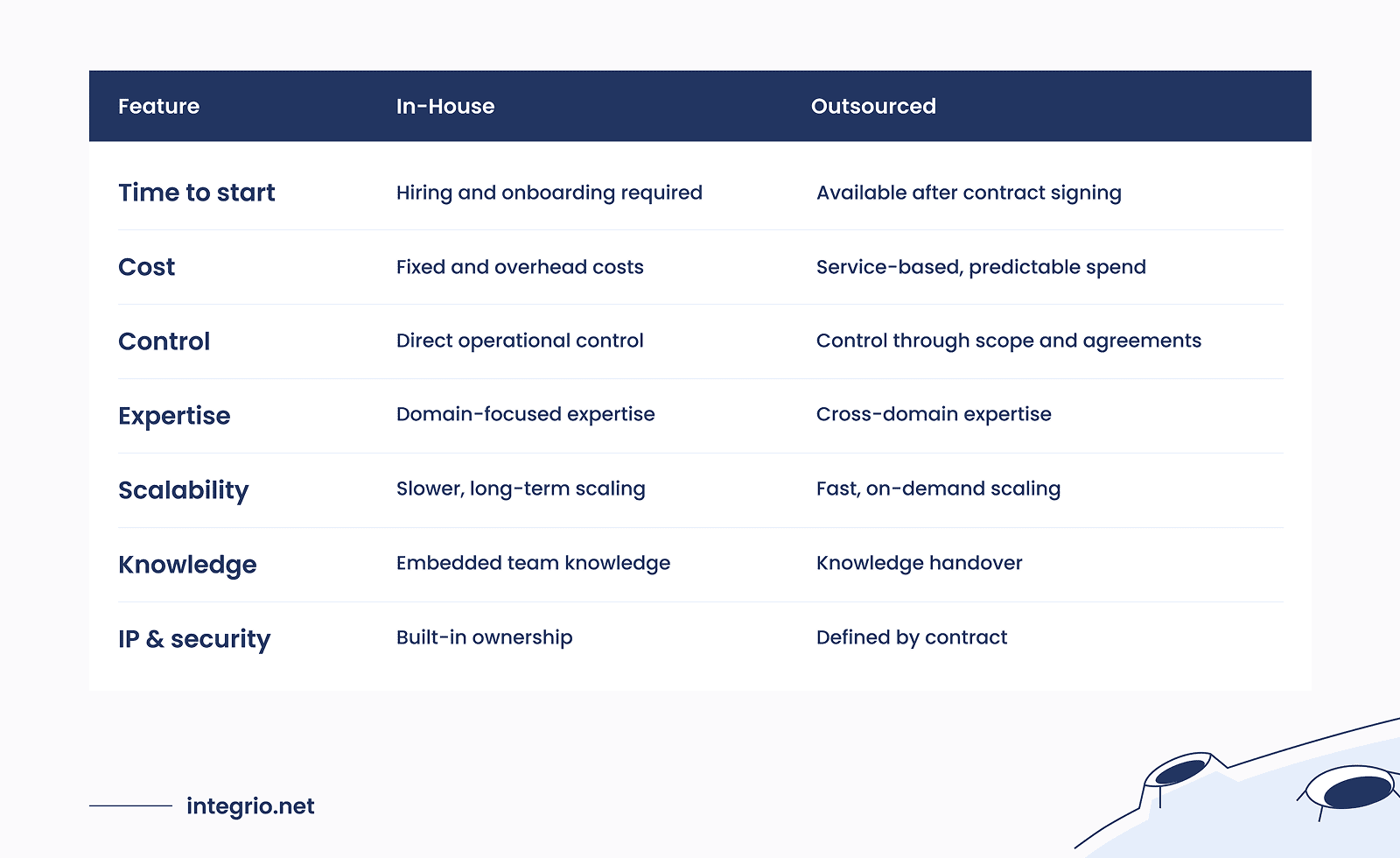
With definitions out of the way, let’s compare in-house vs outsourced engineers on a set of specific factors. First up, how long it takes to get their work going. With an in-house engineer, you have to find and recruit them, go through the hiring and onboarding processes. Meanwhile, an outsourced team or engineer is ready to go as soon as the contract is signed.
Next, a cornerstone for most employers, is the question of the cost. Working with an in-house hire means you know exactly how much you’ll pay them, and the number stays the same regardless of workload. For outsourcing, you typically pay based on services rendered, and the price can vary from month to month. However, the cost is still easy to understand and calculate.
Next comes the control. Outsourcing reduces the ability to micromanage and fine-tune every detail, which some may dislike. Then, the issue of expertise: outsourced specialists have broad industry knowledge. On the flipside, an in-house expert will usually be someone with a deep focus on your field.
Outsourcing also offers scalability, as you can easily hire more engineers and consultants with minimal time and effort. However, it does run into the issue of handing off project- and ecosystem-specific knowledge, which is simplest for in-house teams with full documentation access.
Lastly, anything your in-house engineer creates is owned by your company, whereas ownership of outsourced work is defined in the contract. You can obviously arrange the same terms as with in-house development, but it’s still another thing to include in the already complex legal work.
Pros of Hiring In-House
The first and foremost advantage of hiring an engineer full-time is that you have a clear view of what they’re doing and how, and the ability to adjust their course instantly. Plus, they will collaborate closely with other team members, learn your company culture, and integrate.
A direct result of that merging of talent is that your engineer will become the best expert on your products available. Plus, you can “grow” specialists internally, which is crucial for getting ahead of competitors.
Cons of Hiring In-House
Now, for the potential issues of an in-house approach, the first could be a deal-breaker for some: high costs. You’ll be paying out a substantial salary for an AI expert, as well as the typical full-time employee benefits. Training that person to integrate into your network will also incur extra costs and take time, in addition to recruiting them.
Another complication is that many companies are vying for the best engineers, so securing one for your contract is already complex. But retaining one long-term is an even bigger challenge. Lastly, they may be skilled at producing a specific product but may not necessarily integrate it into your ecosystem.
Pros of Outsourcing
On to outsourcing and its advantages: an outsourced engineer or team can begin work much faster than an in-house hire. They don’t need to go through lengthy onboarding or get to know the internal workflows. Instead, they start as soon as possible and apply their cross-industry expertise to your project. Most outsourcing agencies boast experience across the full spectrum of technologies, making them well-suited to challenging projects.
You also gain greater control over project costs by setting the scope to fit your needs and budget. If you can accommodate additional expenses, you can easily scale the team and expand the budget accordingly. This works thanks to the general flexibility of outsourcing collaborations, where you can go from a single engineer to a full-stack team as needed.
Cons of Outsourcing
As with in-house work, outsourcing does have its flaws. The core issue is that an outsourced engineer or team is likely to be on the other side of the world from your office. That means they aren’t as involved in day-to-day product integration and usage. This could complicate operations, especially if you’re in significantly different time zones.
You will also need to ensure that any data your outsourced vendor has access to is properly secured and that the contract includes responsible use of sensitive data. Ironclad NDAs and heavy penalties for breach must be included, just in case. It’s also key that you discuss the end-of-project procedures. The engineer should provide ample documentation and guidance to your in-house staff that allows them to run it efficiently afterward.
In short, problems in outsourcing often arise from a disconnect between in-house operations and the distant (literally or culturally) engineer. The key to addressing these lies in effective management, communication, and comprehensive reporting.
Cost Breakdown
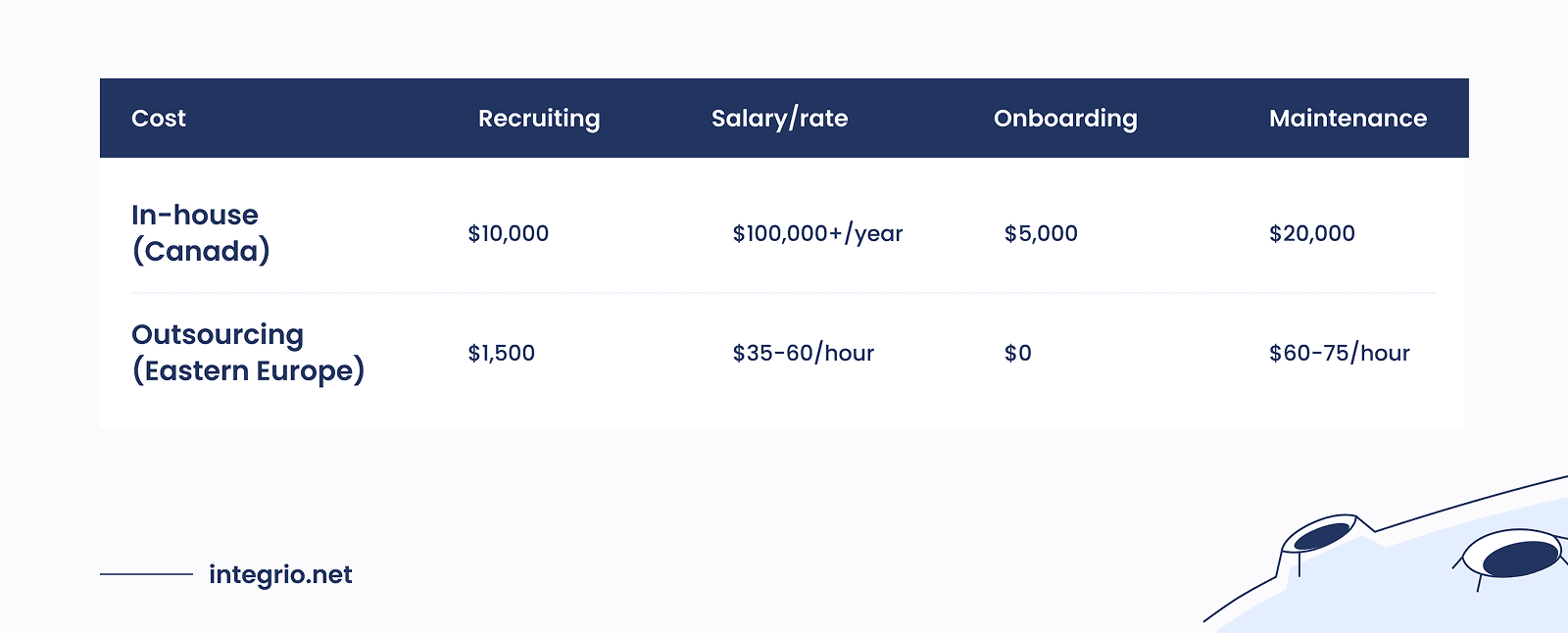
Both approaches to computer vision have their own costs, so let’s break down what that means. For expenses unique to the in-house option, we can single out:
Recruitment fees;
Salaries and benefits;
Infrastructural costs;
Ongoing training and retention.
Recruitment fees are, of course, the first expense you run into and include the funds you spent searching for candidates, interviewing them, and agreeing on their contract. Considering how competitive the market is, this can snowball into quite a substantial sum. That expense is followed by the employee's salary and benefits, as agreed. Given that you need to offer above-average conditions to attract them, the cost may be quite steep.
Once you’ve agreed on the contract and the engineer comes aboard, you’ll need to provide them with office space and all the necessary equipment and working conditions. We wouldn’t consider this to be the most pressing cost, but it can still be noticeable.
Similarly, training and onboarding shouldn’t break the bank, but they must be accounted for in the breakdown. Lastly, retaining a specialist like that will mean increasing their pay and offering extra benefits, which can significantly increase expenses.
Meanwhile, outsourcing is different in that its core expense is just the sum you pay for the project. But that sum varies based on the following:
Project scope;
Overtime or crunch time pay;
Location- and region-based rates;
Team size.
The project scope is under your control, and you can adjust it as needed. However, remember that more ambitious work will often result in overtime pay, which should be discussed in the contract. Sometimes it’s easier to delay the project launch than to pay a substantial additional fee.
You can also control the team size and the location you hire from, though this will depend somewhat on your desired skill set and project complexity. A single engineer can integrate a pre-made computer vision model into your system easily, but building an AI solution from scratch requires more resources.
When to Hire a Computer Vision Engineer In-House
First, you should estimate how important computer vision is to your plans. If it’s at the heart of your business transformation, it’s best to retain your expert in-house. Typically, this is applicable to companies that center their work around AI and ML features. Similarly, those who want ironclad control over their IP may prefer an in-house department, provided their budgets can accommodate it.
When to Outsource Computer Vision Engineering
Alternatively, you may want to consider outsourcing if your priority is to deliver high quality on a tight budget or under tight deadlines. Its speed and favorable rates make it well-suited for companies that need a specific project completed. It’s also viable for businesses that don’t yet have internal AI experts and want to keep their options flexible.
Hybrid & Flexible Approaches
It’s also possible to take advantage of both models by mixing them at your convenience, such as by recruiting a freelancer and, once they’ve proven their skill, hiring them full-time later.
Alternatively, you can augment your internal team with additional remote staff, offering the benefits of outsourcing while also providing the deeper integration that comes with in-house hires.
Plus, you can outsource the strategic work to cut the cost of analytics and research, while your internal teams will then handle deployment. This works well because in-house specialists know your ecosystem, while external analysts may have a broader view of the market.
Possible Scenarios
Let’s consider two cases based on our team's market experience, one focused on outsourcing and one on in-house hiring. First, a case where a smaller company simply needs to prove its ideas to potential customers and investors. In the startup world, speed is crucial if you want to stay afloat, so outsourcing seems like a prime choice.
As smaller companies and startups usually don’t have the widest roster of talent, they’ll definitely need external hiring, and with speed being a priority, a vendor comes through. Work begins immediately, and within just a few months, a polished solution is delivered.
On the flipside, let’s take a major enterprise that seeks to create and support a custom product with computer vision at its core, such as a complex warehouse management and automation system. While it could certainly be handled by an outsourcing team, hiring an in-house team might be a better option in some cases.
If financial resources are not a constraint, long-term projects benefit from a dedicated team with consistent access to the right resources. This team can be fully in-house or built using a hybrid model that combines internal staff with a long-term outsourced team.
Practical Tips for Success
Here’s a short rundown of how you can optimize collaborations with both in-house and outsourcing engineers to ensure success. For internal hires, this includes a focus on efficient, quick onboarding, a clean documentation and reporting pipeline, and a product-centric experience.
Meanwhile, outsourcing teams will thrive if you set clear limits on the project scope and goals beforehand, define ownership of the work in the contract, and agree on reporting in advance. This will allow your internal team to easily take over any duties related to product use and maintenance.
Conclusion
We’re at the end of our guide to hiring computer vision engineers and picking the right path between in-house and outsourcing. You saw the pros and cons of both approaches, as well as a simple breakdown of the factors that influence their cost. By now, you can see that neither choice is poor in and of itself. Your company’s strategy, budget flexibility, and general goals will determine which works best for you. Some may want a full in-house department, others will be fine with just a freelancer.
Our main advice as we conclude our coverage is to analyze your situation and make decisions based on it. While Integrio Systems is ready to offer its specialists for custom development and AI consultations, our philosophy is that data is key. Analyze your capabilities, needs, and potential, and once you’re ready, start your computer vision project.
If you feel that your business could benefit from long-term reliance on computer vision, i.e., for warehouse management, quality control, or theft prevention, it makes sense to have a long-term contract. However, that’s a possibility both with outsourcing and in-house. The real test is whether computer vision accounts for a substantial portion of your operations and requires presence in the office. In that scenario, in-house may be justified.
You will have an immediate reduction in costs due to cheaper recruitment and onboarding, but may notice an uptick in costs on the actual development. However, most companies specifically seek out agencies to outsource work to based on their more modest pricing. Thus, you should expect more affordable rates overall.
As with any technical specialist, assess their portfolio and expertise in your niche, as computer vision systems can be fine-tuned for very different use cases. Additionally, inquire whether they’ve worked on similar projects and what their documentation approach is. These points will be crucial in determining how well they deliver on their promises and whether your team can take on maintenance and operations duties afterward.
We use cookies and other tracking technologies to improve your browsing experience on our website. By browsing our website, you consent to our use of cookies and other tracking technologies.