
Conversational AI in Retail: Use Cases, Benefits & Examples


Meet Jane, your regular customer. Jane regularly visits your website to check prices or wishlist items. She prefers to buy in-store and uses the mobile app to scan the loyalty card at checkout. If there’s a problem, she emails customer support first. But if she gets on the phone, she doesn’t like to repeat herself.
Customers like Jane can interact with a retailer via six different channels. But no matter the touchpoint, they expect quick, consistent, and relevant responses — no matter the question or request.
Conversational AI in retail can power these responses at every step, from product discovery and order tracking to availability updates and post-purchase support.
Here’s your guide to conversational AI, its use cases, benefits, real-world examples, challenges, and key implementation steps.
What Is Conversational AI in Retail?
Conversational AI is the technology that lets customers interact with a retailer in natural language. Think chatbots on websites or mobile apps and in-store kiosks with voice interfaces. It can also support associates through conversational search.
Older rule-based chatbots could only guide users through a predefined conversation flow or match keywords. Conversational AI assistants are more flexible: they can adapt to the user’s context and intent — and “remember” their preferences and needs over multiple conversations.
Conversational AI is often painted as this new generation of chatbots that provide human-like answers. But that’s not its key strength. Conversational AI systems can pull and act on up-to-date retail data across both digital and physical touchpoints, enabling consistently great omnichannel experiences as a result.
How Conversational AI Works in Retail
Of course, not all conversational AI solutions work the same way under the hood. Their inner workings depend on the use case, business constraints, integration and data requirements, and tech stack.
That said, conversational AI retail systems generally rely on:
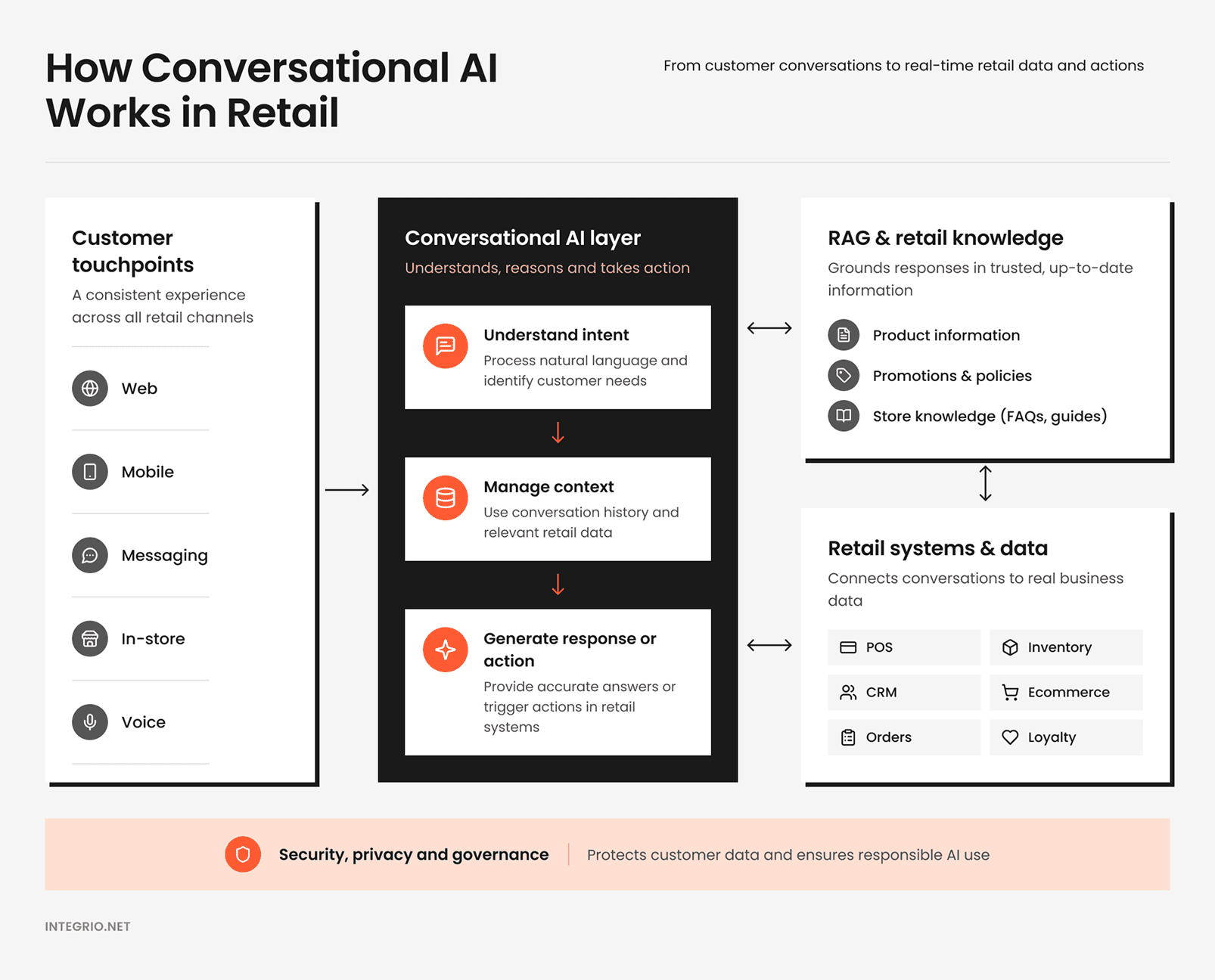
- Large language model (LLM). The model discerns semantic meaning and user intent. Its context window and memory supply relevant information (e.g., conversation history); the model can also request data from other systems. Natural language generation (NLG) turns the output into an easy-to-grasp response that aligns with your brand voice.
- RAG layer. This is how the LLM gets up-to-date information from other systems, databases, and knowledge sources. Thanks to it, the model doesn’t have to guess the return window; it identifies a relevant passage in the policy and draws on it.
- Integrations. Some data resides in other systems (POS, inventory and order management, CRM, loyalty systems; eCommerce platforms). Connecting them to the AI solutions lets it pull fresh data on an as-needed basis.
- Cross-channel data and context. A good retail AI solution unifies data and context across digital and in-store touchpoints. For example, if a customer has spent 30 minutes chatting with an AI shopping assistant on a mobile app, they should be able to pick up the conversation on the website.
8 Key Use Cases of Conversational AI in Retail
Conversational AI may have become synonymous with customer support chatbots, but that’s just one among the many use cases for this technology in retail.
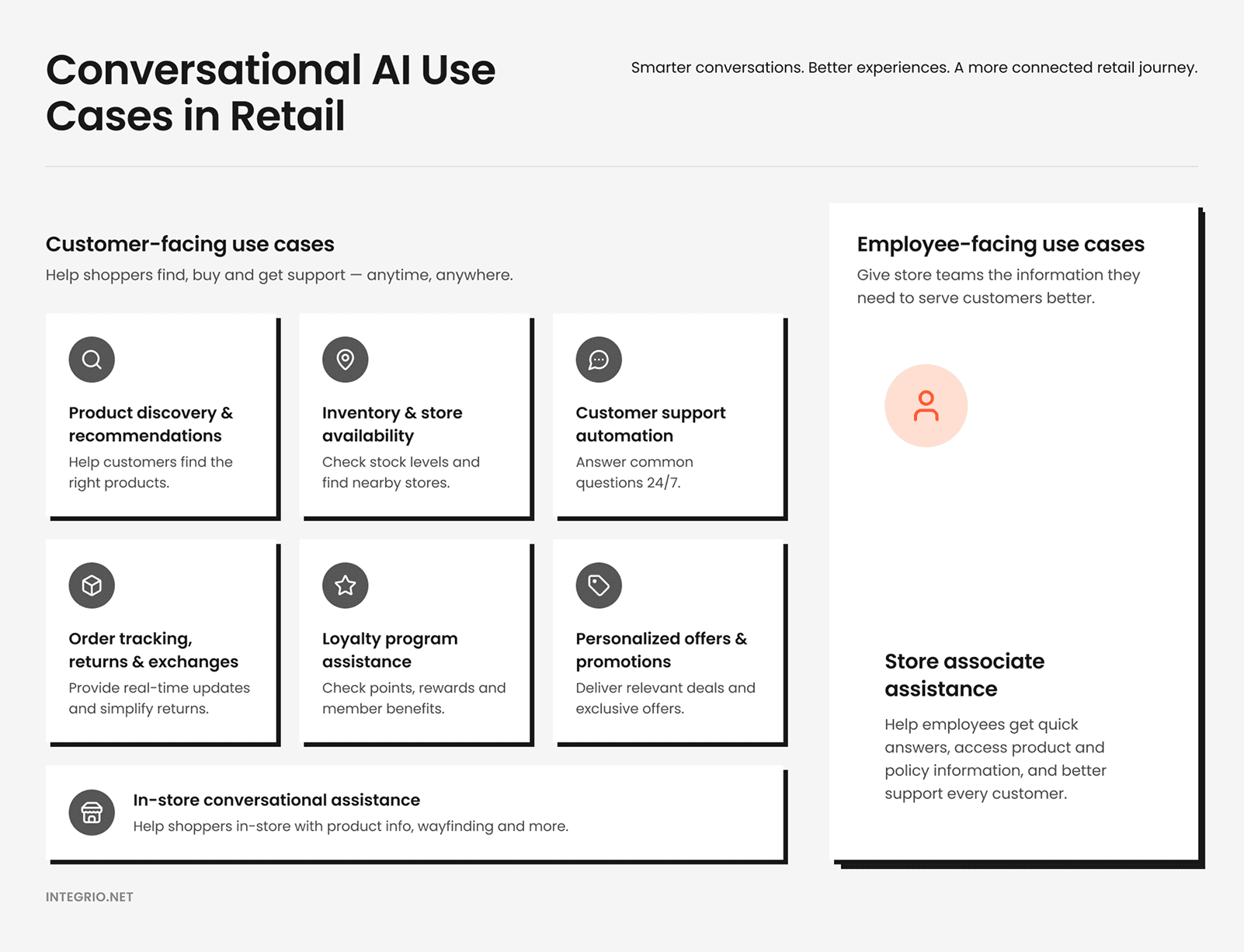
01.Product Discovery and Recommendations
Consumers are already using AI for shopping research; in fact, it’s the third most common use of AI tools in everyday life. A retail AI shopping assistant can bring these consumers onto your website or mobile app, keep them engaged, and help convert them into customers.
For example, AI shopping assistants can recommend products based on very specific requests. A visitor can type in, “I’m looking for a fun gift for my friend’s birthday. He likes Star Wars and Star Trek. I need it delivered in three days tops.” The AI assistant will:
- Check the catalog for suitable items
- Rank them by relevance based on the prompt and context
- Check estimated delivery times
- Generate a comparison table with specs and photos
02.Inventory and Store Availability
“Can I order this jacket and pick it up at your store in Chicago?” “Do you have these red sneakers at your location in Jacksonville?” “Are these headphones available only online or for in-store pickup, too?”
These are just some questions a retail conversational AI assistant can answer. How? One word: integration. Namely, the integration with your inventory management system. With it, an AI assistant can access the most recent data on location-specific stock levels, SKU availability, and pickup options.
03.Customer Support Automation
Consumers want answers quickly, which is why 86% use self-service options before contacting support.
Conversational AI for customer service can eliminate the need to scroll through policies and help center pages. The user can type their specific question, and the system will locate relevant information sources to generate the answer. That question can concern:
- Specific products and their specs
- Payment options and processing
- Shipping costs, delivery times, shipping status
- Refund and return policies
04.Order Tracking, Returns, and Exchanges
Similarly, with other AI technologies, a conversational retail AI chatbot can handle routine service requests from start to finish.
For example, if the item arrived damaged, the chatbot can analyze photos and check order details to determine return eligibility. If everything checks out, it can generate and send shipping labels, along with instructions, to the customer.
Of course, that’s not the only type of automatable routine support tickets. Conversational AI can also:
- Update the customer on their order’s status
- Relay real-time shipping status from the carrier
- Identify the most suitable exchange flow based on inventory data
- Provide post-purchase support (e.g., collecting feedback, answering product use questions)
05.Loyalty Program Assistance
Just like refund and return policies, loyalty programs can be confusing. Conversational AI assistants can make them simpler and more transparent by answering questions like:
- How many points do I have?
- When do they expire?
- What rewards can I use them for right now?
- Can I combine a reward with another discount code?
- How do I earn points or rewards?
What’s more, AI loyalty program assistants can proactively recommend rewards based on the customer’s profile and long-running preferences. Or, they can remind customers to use their perks before they expire — and even redeem rewards on their behalf when asked to.
06.Personalized Offers and Promotions
Just like conversational AI assistants can recommend relevant rewards, they can also suggest the right deals for every customer. Targeted promotions aren’t just something consumers like; they also generate a 1% to 2% increase in sales and up to a 3% rise in margins.
With conversational AI and predictive analytics, there’s no need to sort customers into buckets anymore:
- Predictive analytics will determine the most relevant offers based on the customer’s context, purchase history, and preferences.
- An AI chatbot for retail will tailor messaging to each customer, making content unique.
07.In-Store Conversational Assistance
Locating and approaching a sales associate at a store to ask a quick question often takes too long. Walking to a kiosk and speaking to an AI concierge does not. Taking out the smartphone and asking the in-app voice assistant or chatbot is even faster.
Whatever the medium of assistance is — a kiosk, mobile app, or voice interface — conversational commerce retail solutions can instantly help customers:
- Locate a specific product at the store
- Navigate the store when picking up multiple items
- Check whether an item is in stock
- Learn more about the product and its specs
08.Store Associate Assistance
While customers definitely stand to benefit from conversational AI helpers, the technology can also make associates’ lives easier. An AI assistant that’s always in their pocket or on their tablet can help them:
- Quickly look up relevant product information
- Check stock levels for specific SKUs
- Verify promotions and their rules
- Get answers to policy- or compliance-related questions (refunds, returns, etc.)
In this case, conversational AI eliminates the need to navigate multiple pages and menus, type keywords, or hit Ctrl+F in long documents.
5 Benefits of Conversational AI for Retail
As you can see, there are many ways conversational AI can transform customer experiences, reduce customer support load, and streamline in-store operations. Together, these use cases let retailers reap benefits like:
01.
Happier customers. With conversational AI chatbots, shoppers can find answers to almost any question instantly, on the first try. Product discovery — and support from pre- to post-purchase — also becomes faster and more convenient.
02.
Higher conversions. Convenience isn’t just great for CSAT; it also removes friction that would otherwise cause customers to abandon their cart or go elsewhere. Rep AI found that conversion rates are four times higher among shoppers who use AI chat.
03.
Leaner operational costs. Retail automation AI solutions that handle routine support tickets end-to-end let you do more with the same headcount. Customer-facing in-store assistants also deflect some shoppers’ queries.
04.
Grade-A omnichannel experience. Customer conversations and preferences seamlessly carry from mobile over to website and in-store channels. The secret? A unified data layer that powers conversational AI solutions.
05.
More productive employees. When conversational AI meets enterprise search, customer support reps and store teams stop wasting time hunting down information. No more hopping between systems, tweaking queries, or checking multiple pages.



Ready to make conversational AI part of your daily retail operations?
Conversational AI vs Traditional Retail Chatbots
You might think that AI chatbots simply generate more lifelike responses compared to their older counterparts. But that’s not all: they also process requests, maintain context, and use retail data differently compared to traditional chatbots.
| Aspect | Traditional Chatbots | Conversational AI Chatbots |
|---|---|---|
| Conversation flow | Follows preset rules and branches | Adapts to real-time intent and context |
| Scope of requests | Can handle only a predefined range of questions and instructions | Can respond to diverse natural-language prompts |
| Responses | Returns mostly predetermined answers | Generates context-aware output based on up-to-date data |
| Data access | Typically limited; can use only specific connected sources | Can work with a wide range of retail data (product, inventory, order, loyalty, etc.) |
| Impact | Helps users complete specific tasks to meet narrowly defined needs | Supports more flexible interactions across touchpoints |
The bottom line is, conversational AI solutions for retail sales go beyond generating more lifelike answers than rule-based systems. They also take context into account, pull data from other systems as needed, and handle more complex interactions, be it with customers or employees.
4 Real-World Examples of Conversational AI Used in Retail
The diversity of conversational AI use cases in retail is already evident in real-world applications. Some retailers use the technology to launch full-fledged shopping assistants; others deploy employee-facing tools instead. For example:
01.
Walmart. The retailer’s AI shopping assistant, Sparky, helps customers find products, plan meals, and restock commonly bought items. It can also find information in reviews and pick supplies for themed parties.
02.
Lowe. Lowe developed and launched two AI assistants in partnership with OpenAI. Mylow helps customers find products and answers their home improvement questions. Its counterpart, Mylow Companion, helps associates across 1,700+ stores instantly access product details, project advice, and inventory information.
03.
Target. This retailer took notice of the skyrocketing rise of AI-driven traffic (up 2,000% YoY in Q1 2026). But instead of launching assistants on its own channels, Target partnered up with Gemini, ChatGPT, and Microsoft Copilot. Users can explore Target’s products, create multi-item carts, and even connect their loyalty accounts without ever visiting Target’s website or opening its mobile app.
04.
Albert Heijn. This Dutch grocery chain used Azure AI Foundry to build Steijn, a meal planning assistant for its mobile app. It uses its access to 20,000+ Albert Heijn recipes to answer prompts and suggest meals based on photos of items in the fridge.
As you can see, conversational AI can serve a variety of purposes. Some retail solutions use the technology to facilitate product discovery and shopping. Some support employees in their daily work or facilitate loyalty-connected commerce. And some offer specialized help — like meal planning — within their apps.
6 Challenges & Considerations to Know Before Implementation
As much as we’d like it to be otherwise, deploying conversational AI is rarely a straightforward journey from point A to point B. Retail solutions are no exception. Here’s why:

Data quality and consistency. Data can make or break any AI system’s output. So, your conversational AI solution needs access to relevant, fresh, consistent data on products, pricing, inventory, promotions, stores, policies, etc.
Interoperability with other systems. Retailer operations often run on legacy systems. But even when they don’t, systems can use different APIs, data formats, or architectures. That can make integration with POS, inventory, CRM, order management, loyalty, and other systems challenging, to say the least.
Response accuracy and hallucinations. Stale data is often to blame for incorrect responses, but hallucinations can occur even when all data is fresh. Needless to say, if the AI assistant gets pricing or availability wrong, customers may feel misled — and abandon their purchase.
Conversational UX. The channel selected will impact UX design. For example, conversational AI mobile shopping UX retail solutions can benefit from voice assistance, unlike website chatbots. You also need to define when the AI assistant should ask follow-up questions — and when it should hand over the conversation to a human.
Privacy and compliance. Customer profiles, purchase history, loyalty data, and payment-related information are all sensitive data. If your system uses this data, it has to be designed with compliance in mind.
Cross-channel context. If you want to deploy AI in omnichannel retail, pay extra attention to context and memory across channels (web, mobile, messaging, in-store). If the system doesn’t retain cross-channel context, it may return contradictory output — or force users to repeat themselves.
How to Implement Conversational AI for Retail
Many AI initiatives fail to meet goals because businesses overlook critical steps like picking the right use case or preparing data. Here’s how to avoid these and other pitfalls during implementation, as per our experience:
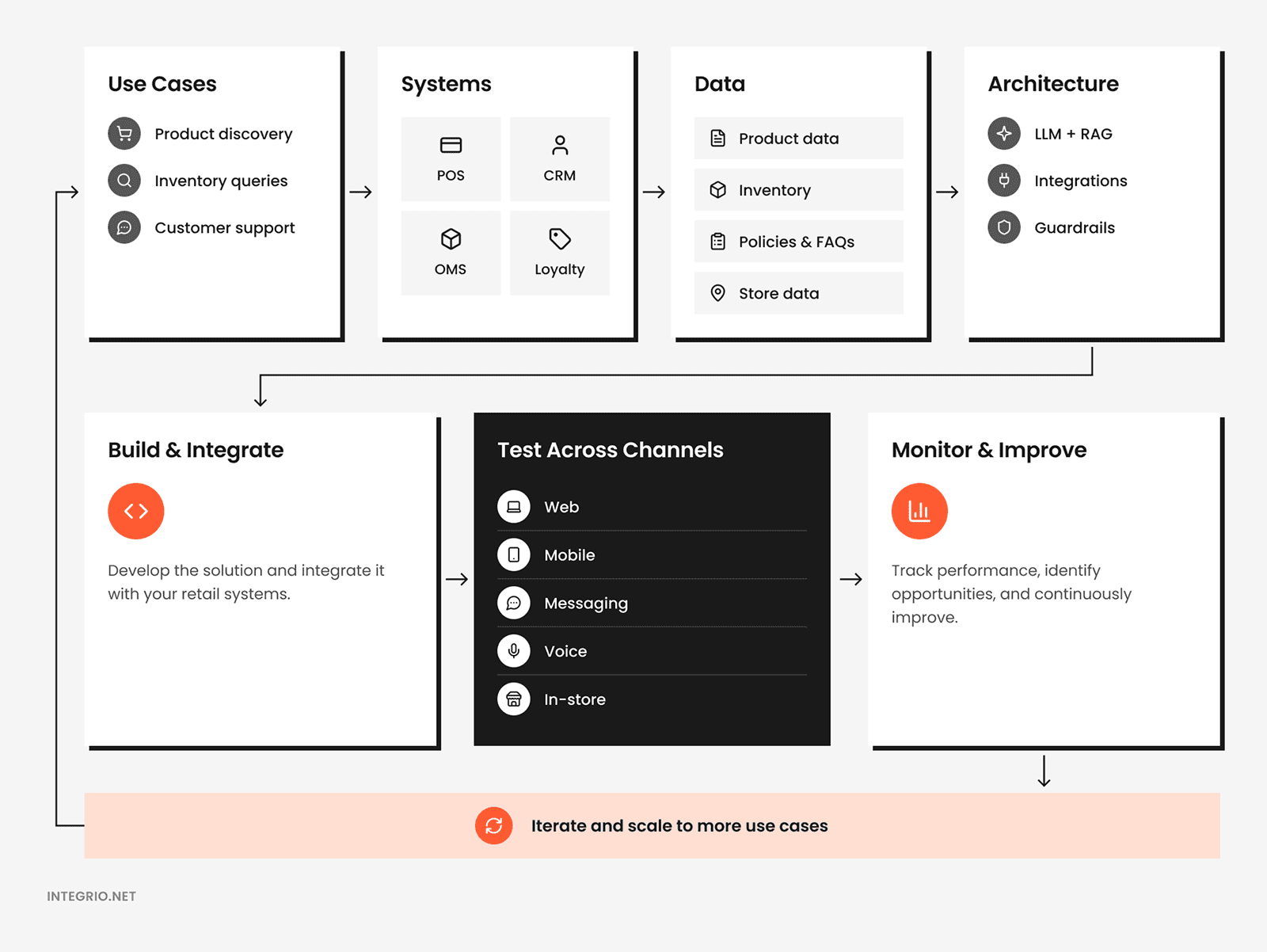
- Define use cases and goals. Start with one or two high-value use cases: product discovery, inventory queries, self-service support, associate copilots, etc. Define what success will look like — and pick the KPIs to track your progress toward it.
- Map retail systems and data sources. What data will your system need? Common answers include product, inventory, pricing, order, customer, loyalty, and store data. List all the integrations required to supply it (e.g., POS, CRM, eCommerce platform, OMS).
- Prepare data and knowledge sources. Your data has to be structured, up to date, and ready for conversational AI. So, check your product information, policies, FAQs, promotions, store information, and other knowledge sources before development.
- Design the solution architecture. This architecture will define how the LLM, RAG layer, backend systems, and user-facing channels interact. Define access controls, guardrails, human escalation rules, and orchestration flows at this stage, too.
- Build and integrate the solution. Developers work in iterations to build the system and integrate it with retail platforms and internal systems. Continuous testing helps weed out bugs and errors early on.
- Test across channels and scenarios. Before rollout, put your system through a final round of testing. Validate response accuracy, integrations, edge cases, human handoff, and cross-channel consistency.
- Launch, monitor, and improve. Any AI system in production needs monitoring and refining. So, track unresolved requests, response time, and resolution and escalation rates. Keep an eye on business metrics like conversion rates and operating costs, too.
Conclusion
Conversational AI is by no means limited to a single use case in retail. It can streamline both product discovery and customer support. It can provide a new generation of inventory, order, and loyalty assistance. And it can make associates’ lives easier with in-store support.
You don’t have to use existing AI platforms to create your solution. You can also build a custom AI model if you have stricter requirements for model and cost control, integrations, security, and deployment.
Keep in mind, however: the LLM you choose or build isn’t the only thing that will impact your solution’s ROI. It’ll also depend on the quality of your data, integrations with other systems, response accuracy, and cross-channel consistency.
Don’t try to embed conversational AI everywhere from the get-go. Start with a high-value use case, measure its business impact, and then expand the system to other workflows.
Not sure where to start? Integrio Systems can help you evaluate and prioritize use cases, design a scalable architecture, integrate the solution with your systems, and safely deploy it to production. Explore our conversational AI services to see how we do all of that — and more.
FAQ
First, define what will constitute success for you: e.g., higher conversion rates, increased average purchase value, support ticket deflection. Measure metrics before implementation to gauge the status quo — and keep tracking them once conversational AI is in place.
In retail, conversational AI systems usually need access to data about the products, pricing, inventory, promotions, loyalty programs, stores, and policies.
Absolutely. Conversational AI systems use APIs to retrieve data from other software like POS, CRM, inventory and order management, and loyalty systems.
Make sure conversational AI has access only to fresh, up-to-date information. If the system keeps retrieving irrelevant — but accurate — information, improve chunking and knowledge base entries. Preventing hallucinations, in turn, requires guardrails and an evaluation layer.
Yes. In-store kiosks and AI assistants in mobile apps can offer quick in-store help via voice interfaces. Associates, in turn, can use conversational AI to access product and inventory data.
Conversational AI interprets natural language requests and generates context-aware, human-like responses. AI personalization tools analyze customer data and behavior to do things like evaluating churn risk or displaying targeted product recommendations. AI personalization tools can provide extra context for conversational AI, but conversational AI can’t replace them.
Long support wait times and high routine ticket volumes are signs you should look into conversational AI for support. High cart abandonment rates, low conversion rates, and low CSAT indicate you could benefit from conversational AI shopping assistants.
Contact us
