Many companies around the world opt to outsource their projects to minimize the software development cost while still getting top-shelf quality. Though much has already been said about the industry, it’s evolving, and trends shift and adapt. Right now, many are turning to the dedicated development team model over other outsourcing options, and we want to explain why.
We’ll talk about the model itself, the fluctuating cost and quality levels around different regions, and how typical project budgets are formed. Knowing factors that make up app and web development cost, as well as the warning signs of unreliable partners, will help you find a trustworthy team with reasonable rates. Without further ado, let’s begin.
What Is a Dedicated Development Team
So, the thing that sets apart dedicated teams from other software development outsourcing models is that you’re paying for the devs to work solely on your project. In contrast, the same team can be hired under a pure outsourcing model. Yet, they may then be tackling multiple projects at a time. As a result, work goes more slowly, the team setup may change as their workload shifts, and longer development time also entails higher expenses.
In most cases, a dedicated team includes a full-stack line-up, such as:
Senior or mid-level developers;
QA staff;
A project manager;
A designer;
DevOps specialists.
This general make-up may change to match your needs, though it will, of course, affect the team cost. Overall, though, it’s a great model for specific use cases, such as projects with long-term prospects, scaling efforts, tightly controlled offshore software development, and more.
How Location Affects Dedicated Team Costs
We’ve mentioned that different regions have varying work quality and cost efficiency levels. So if you want to hire a dedicated development team that matches your budget, here are some prime areas.
Canada
Whether you’re looking at software developers in Toronto or an IT company in Vancouver, rates will be admittedly steep. Still, they are lower than you’d get in the US, while the skill sets are very similar. Canada boasts professional teams with strong communication skills and structuring. It also works great for those who want nearshore custom software development with a maximized cultural fit.
USA
Pricing data for the US tends to consistently show it as the most expensive region, though it has the advantage of multiple time zones, which are compatible with other major tech hubs. Plus, like Canada, there’s no language barrier or cultural fit issues, while collaborative skills are fairly high. However, having a more reasonably priced neighbor just up north, the US now makes the most sense for those who definitely don’t want an offshore team and prefer local talent.
Europe (Ukraine, Poland, Romania)
Meanwhile, those wanting moderate developer rates should look to the eastern parts of Europe, as it features plentiful talent markets with very friendly prices. Most IT professionals have solid English proficiency. Overall, these countries tend to host major tech hubs with ample developers and sufficient time zone overlap.
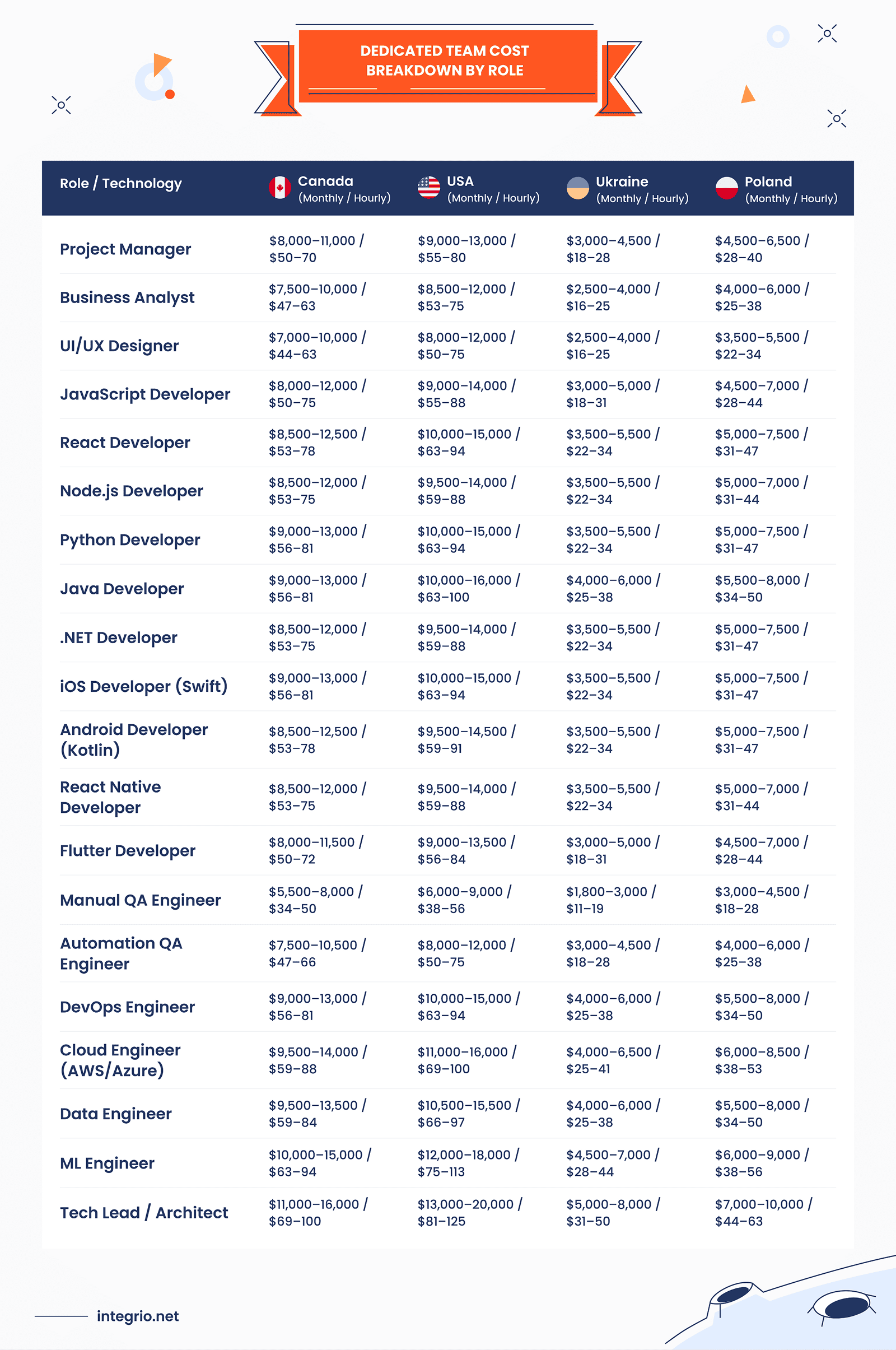
Dedicated Team Cost Breakdown by Role
In order to give you a better understanding of your potential project cost, we want to showcase specific team rates based on the region.
When we talk about how we fill IT vacancies, it’s important to understand that cost will always be a key factor. You can see for yourself that some locations have 3x the rate of others, leading to a higher total cost. Most clients will try to find a team that strikes the right balance between the average cost, work quality, and reliability. As a result, many choose to work with European vendors, who represent the middle ground and mitigate development costs.
What Factors Influence the Total Cost
In order to make an accurate cost estimation, you need to understand which components make up the rate, so let’s take a brief look at them. The chief factor is the team composition and size of your app development team. The more people and the better the experience, the higher the cost.
The tech stack and expertise you require are also crucial, as niche industries demand specific talent that is limited in supply. Plus, you have to consider the cost of managing these specialists and the timeline that they commit to. Projects also involve extra work beyond just feature development, such as:
Building relevant infrastructure;
Integrating the project with other tools;
Recruiting extra team members;
Bolstering security and getting necessary clearances.
Sample Dedicated Team Configurations and Costs
We’ll enhance our pricing guide with some basic examples of what you can expect with different software development companies.
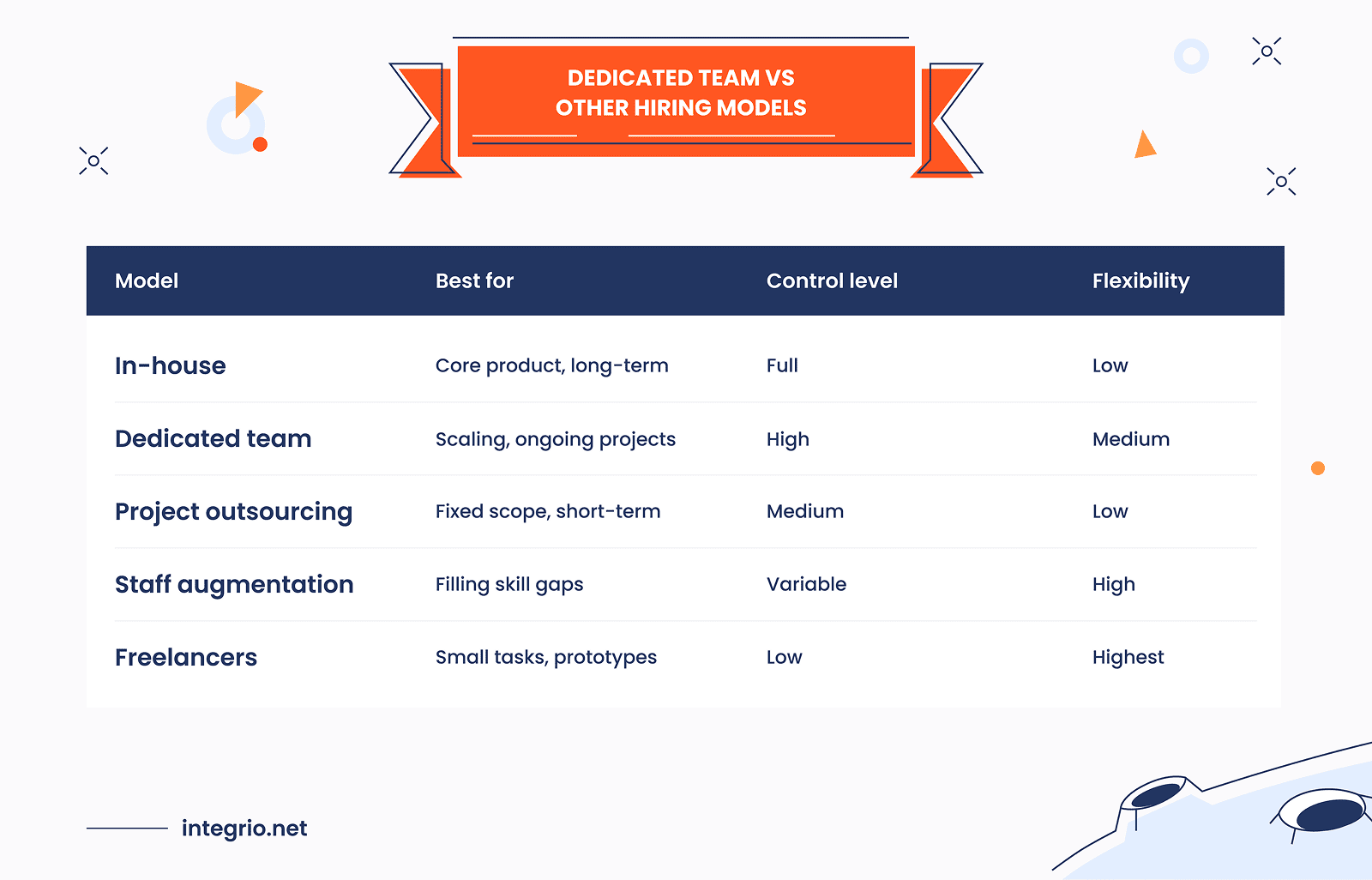
Here’s an overview of how dedicated teams stack up directly against other collaboration and pricing models.
Hidden Costs to Account For
Understanding the full software development cost in 2026 also requires recognizing the hidden expenses that often accompany such projects. To start, you must remember the team won’t be running at 100% productivity for the first month or so. This period covers the team’s onboarding and the time it takes them to ramp up work, learn your needs and goals, and understand your company’s ecosystem.
Second among the hidden costs are expenses for tools used during development, such as PM tracking and logging tools and communication software to keep the team connected. These aren’t major expenses in the grand scheme of things. However, on long-term projects, they tend to add up.
Then there are the expenses of transferring relevant knowledge and data between providers, should you need to switch them. Similarly, potential overlap with your internal team could incur costs that are entirely avoidable if the work is structured to avoid repeat tasks.
Lastly, for the cost breakdown you must also remember about the legal fees that go into drawing up the contract and pre-work negotiations. Also, depending on your industry, you may need to run additional security audits on the product to ensure its legal compliance, which will cost a bit more.
How to Calculate Your Dedicated Team Budget
Now that we have covered software development pricing, let’s talk about how to use that information for overall budget calculation. It should include multiple cost drivers, such as the project’s scope and predicted duration. Then, calculate how many people the team needs and what their seniority level should be. Once you have all that, pick your sourcing region and calculate the base cost per month. Then you need to add the overhead, generally increasing the budget by 10–15%.
After all of that, you can add in tools and infrastructure costs and bake in a small buffer to ensure your project can navigate any challenges and obstacles. The buffer should be around 15–20% to cover most situations.
To sum up, the total budget can be counted by using a formula like this: (Monthly Cost + Overhead) × Duration × 1.15–1.20
How to Reduce Costs on a Dedicated Development Team Without Sacrificing Quality
Rounding out our coverage of development team pricing, here are some practical tips to make your software development more affordable without compromising reliability. Firstly, we suggest starting with a smaller team and scaling only if you find it necessary based on results. Plus, don’t go for senior devs right away. Instead, mix and match to see which levels of expertise you need, and if you do need senior talent, consider sourcing it from Europe.
Comprehensive documentation may seem like an extraneous expense, but it simplifies maintenance and updates, as well as product iteration later in the dev cycle. Given that most dedicated teams are hired on longer-term contracts for greater efficiency, this documentation will certainly come in handy.
Lastly, if your project to make, for example, enterprise software, doesn’t need a Java developer at all times, then you can hire them part-time at a lower rate. It’s a nice compromise to get what you need without overpaying.
Red Flags When Evaluating Dedicated Team Providers
The clearest warning sign is when a vendor tries to undersell everyone else with a truly minuscule hourly rate. Teams like that tend to have pretty high turnover, which you can spot by studying their site and client reviews. It’s also important to analyze their case studies and see if their stated skills match your needs. Besides, beware of unclear replacement policies, or you risk being left short-handed in the middle of the project.
We also recommend focusing not just on hard skills but soft ones too, as faulty communication or lack of legal clarity in contracts can and will lead to problems later on. Trust your instincts and don’t put cost reduction as the core goal of your work with a vendor. Their main purpose is to deliver a high-quality product, and these red flags are clear signs you won’t be getting it.
Conclusion
To finish up, we reiterate that dedicated team cost isn’t a monolith and can be minimized by opting for a junior or middle dev instead of a senior developer. Similarly, picking a vendor from a less expensive location is a good move, though trying to find the absolute cheapest option is risky. Instead, seek a balance between cost and quality.
A great way to do so is to partner with Integrio Systems, a Canadian company with dev teams in Ukraine and Poland. We combine Canada's high professionalism and quality with Europe's cost range to deliver top-notch product development suitable for the competitive 2026 market.
FAQ
A good vendor will provide a development team in just a few weeks or one month, with most of the time spent on confirming members and drawing up contracts.
Depending on your contract terms, they can be either quickly replaced with no fuss or the vendor would be at fault for changing the team structure and pay out a fine accordingly.
Yes, as long as it’s been negotiated beforehand and the vendor has an available software developer to take the spot. The team size is up to the client, as long as the budget allows it.
In most cases, the intellectual property is transferred to the client once the project is completed and paid for. The terms should be clearly defined in the contract with the software development team, including ownership of the code, designs, and related assets.
IP ownership is not typically tied to the total cost of ownership, but it is an important part of the overall agreement and should be clarified upfront.
We use cookies and other tracking technologies to improve your browsing experience on our website. By browsing our website, you consent to our use of cookies and other tracking technologies.