Let’s say you’ve set the budget for digital transformation. Maybe you’re automating a clunky process, migrating a decade’s worth of legacy data, or building something entirely from scratch. Regardless of the task, the question is: who’s going to perform it?
As a Canadian business, you have two broad options. You could build an internal team right here at home, offering maximum control but with complex recruitment and high overhead costs. Or, you could look offshore, where significant savings are offset by potential communication friction and data residency concerns. Add to it the difficulty of distinguishing who’s actually built enterprise-grade systems and who’s just really good at promoting themselves.
Here’s how to separate the true long-term partners from the mere “order takers.”
Understanding Enterprise Businesses and Their Software Needs
First of all, an enterprise is a larger business. But, of course, it’s more than that.
Compared to startups or SMEs, it operates on a completely different level in terms of structure, scale, and accountability. It includes multiple departments and locations, large customer bases and number of employees, numerous revenue streams, and a complex operational infrastructure to take care of.
And this scale changes everything when it comes to software.
While a startup might need an app that just works for a few thousand users, an enterprise is a huge ecosystem. Here’s why its needs are fundamentally different:
Integration. Enterprises typically use a whole suite of software solutions: ERPs, CRMs, analytics tools, and so on. These must connect seamlessly to a new enterprise platform without disruptions, or worse, data loss.
Security. The math is different for enterprises. More users and more data mean a much wider attack surface. What would be a minor inconvenience for an SME might become a multi-million dollar liability for an enterprise.
Scalability and stability. The enterprise system must handle thousands of concurrent transactions, high user volumes, and massive data loads without performance degradation.
Smaller business software focuses on flexibility. Enterprise-grade solutions, in turn, depend on stability, security, and scale.
Why Canadian Enterprise Businesses Need a Long-Term Software Development Partner
Software is a continuously evolving core asset for any business, especially an enterprise. If you think about it this way, you’ll realize that you don’t need a contractor to build the system and leave. You need a partner who will be there to expand the foundation for years to come.
Here’s why long-term partnerships are so important for Canadian enterprises:
Strategic continuity. Enterprise platforms don’t stand still. They scale and adapt to new business models. A long-term partner preserves knowledge and architectural consistency.
Safer innovation. A partner challenges your assumptions. They’ll tell you when a feature isn’t worth the investment. They align their technical roadmap with your business requirements to make sure you implement only what’s necessary.
Specialized talent on demand. Enterprise initiatives often require evolving skill sets: cloud, data engineering, AI, cybersecurity, integration... Instead of hiring from scratch every time your needs change, a partner gives you instant access to a bench of talent that already knows your system.
Internal Development vs. Outsourcing
When it comes to enterprise software development, the choice is usually between building it in-house and bringing in specialists. Both paths have their champions.
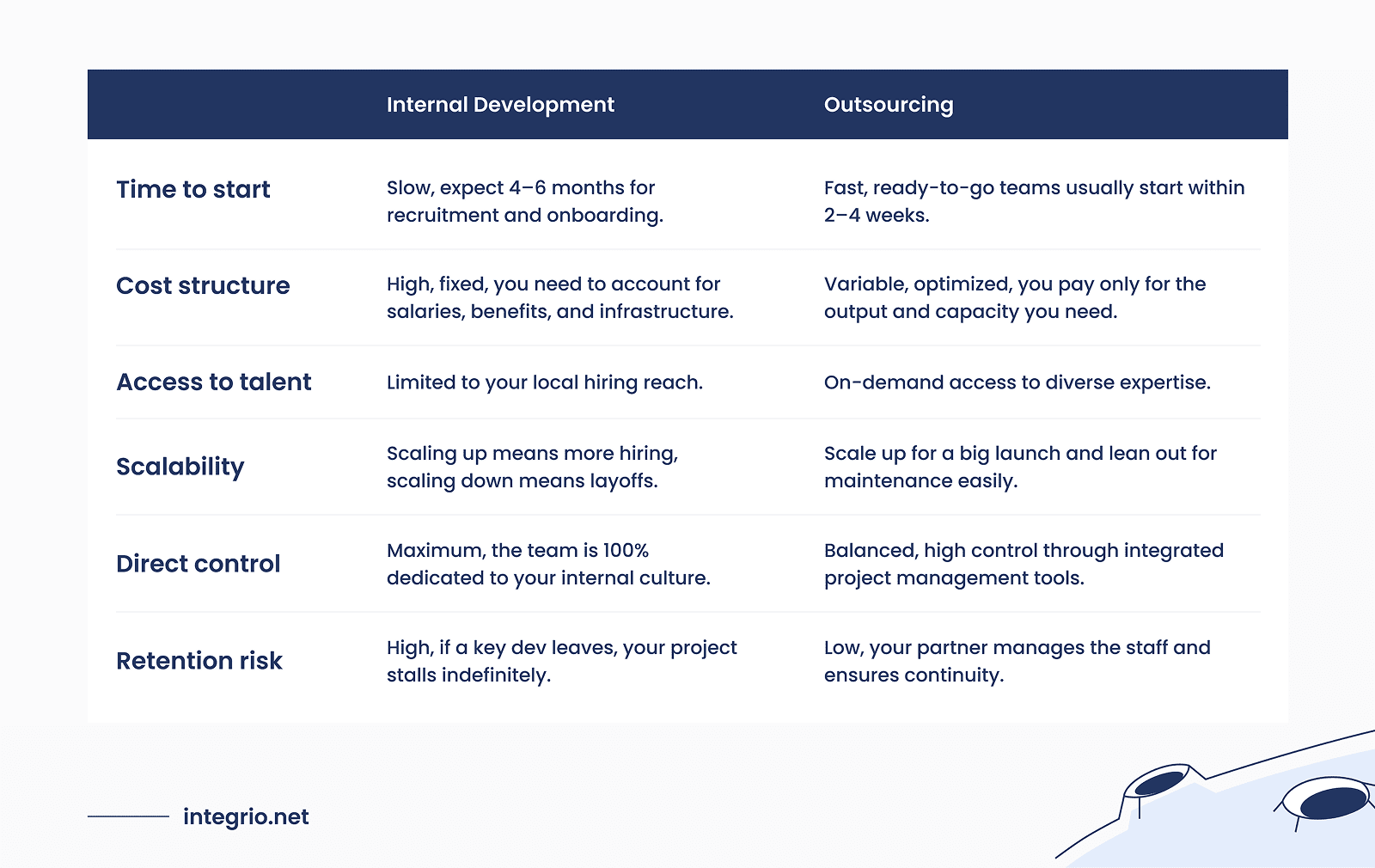
Internal development is the approach of recruiting, training, and managing your own developers. It’s great for long-term cultural alignment, but in the current Canadian market, it’s also a high-stakes recruitment competition. Outsourcing, on the other hand, is about agility, where you partner with an established firm to bypass the hiring lag and get straight to the doing.
Here’s how the two compare:
Which option wins?
Having an in-house team is great for your day-to-day operations. Yet, full-scale enterprise software development is often better handled through a specialized partner. It’s because outsourcing allows you to bypass the talent hunt, avoid technical debt, and focus on your core mission.
Some enterprises may also consider a hybrid model. It involves keeping a small, core team in-house for product ownership and using an outsourcing partner to provide the specialized knowledge and execution speed.
Step-by-Step Guide to Choosing an Enterprise Software Development Company in Canada
Choosing the right partner requires more than deciding between internal hiring and outsourcing. The selection is a multi-layered process.
We typically break it down into two major phases: considerations for your business and those for your software development partner. Let’s get each of them straight.
Phase 1: Internal Considerations
This phase helps you figure out who you are and what you need. Skipping it typically results in partnership mismatches, missed deadlines, and overruns.
Step 1: Define Your Business Goals
Before you evaluate any company, you need to understand why you’re building this software in the first place. So, define what success looks like for you, in measurable terms.
We recommend following the SMART approach. It involves setting goals that are Specific, Measurable, Achievable, Relevant, and Time-bound. With those in place, you’ll be able to explain and justify the business value to your board, dev partner, and end users.
Step 2: Define Internal Challenges
Next, identify what’s slowing you down today. This can be anything from data fragmentation to technical debt. Here’s a simple framework for defining the challenges — and their severity:
The problem. Which processes are currently broken, slow, or manual?
The impact. What is the cost in terms of lost time, revenue, or opportunity?
The scope. What work needs to be done? Do you need a small tool or feature, or an entire enterprise platform?
The constraints. What are the non-negotiables regarding budget, timeline, and data residency?
Once you’ve answered the questions above, document everything.
Step 3: Define Your Budget
Finally, you need to estimate the real cost of enterprise software. Your budget must cover the full development lifecycle: discovery, architecture, UX/UI design, development, testing, deployment, and ongoing support.
Besides the dev expenses, factor in the hidden costs. These, for example, may include cloud hosting or third-party licensing fees. Plus, set aside a contingency fund (typically 15–20% of the entire budget) for unforeseen issues or scope changes.
Phase 2: Software Development Partner Considerations
This phase studies everything connected to your potential software development partner. Follow these steps to vet your candidates:
Step 1: Look for Proven Enterprise-Level Experience
At this point, you need to prepare a shortlist of companies that work at your scale. And, in fact, not every “custom software company” is enterprise-ready.
Review the candidate’s portfolio and website to see if any of the following checks out:
Complex, multi-system implementations.
Long-term cooperation with clients.
Experience with regulated industries.
Case studies that mention scalability, performance, and integration.
Teams larger than just a few developers.
Bonus points if they’ve worked with organizations similar to yours in size or operational complexity.
Step 2: Evaluate the Company’s Ability to Understand Your Business
The best enterprise partners don’t start with technology. They start with questions.
During early conversations, assess whether they ask about your business model, KPIs, stakeholders, user groups, current workflows, and pain points. If a vendor jumps straight to timelines and pricing without deep discovery, promising they can do it all, chances are they’re thinking transactionally.
Step 3: Assess Security, Compliance, and Reliability Standards
Next, you want to evaluate how your potential partner handles security and compliance requirements, and what their approach to risk management is.
They should know how to employ:
Secure development lifecycle practices.
Privacy-by-design approach aligned with PIPEDA.
Role-based access control and identity management.
Data encryption in transit and at rest.
Audit trails and monitoring.
Business continuity and disaster recovery planning.
To assess their knowledge, ask how they handle incident response, penetration testing, infrastructure security, and compliance documentation.
Step 4: Review Communication, Transparency, and Processes
Mature software development companies will have structured and visible workflows.
Look for a clear discovery phase, a defined delivery methodology (Agile, Scrum, and so on), dedicated team roles, regular reporting and demos, and a transparent backlog. Plus, pay attention to their change management process.
At this point, you’re evaluating their collaboration skills, including the dedicated tools they use to make it happen.
Remember, you’re looking for a long-term partner. Because enterprise software is never “done,” you need to make sure your vendor will still be standing (and supporting you) in five years or even a decade.
A reliable partner should offer post-launch scaling, performance optimization, new feature development, regular compliance and security updates.
What signals indicate reliability and long-term thinking? Consider a product-over-project mindset, stable leadership, low employee turnover, and multi-year client relationships.
Conclusion
When choosing an enterprise software development company in Canada, prioritize long-term partnerships over one-off vendors. How to achieve that?
Keep your goals clear, your challenges defined, and your budget reflective of the full product lifecycle. And when evaluating vendors, focus on enterprise-grade experience, security, delivery maturity, and long-term collaboration potential.
Planning a digital transformation within your enterprise? Contact our team at Integrio Systems. We possess all the qualities of a reliable developer: over two decades of experience, long-term cooperation cases, and plenty of enterprise projects with Canadian companies.
FAQ
Standard software is often built for a broad audience. Enterprise development is a different kind of work: it’s built for a corporation’s scale, security, and complexity. The developed software must support multiple departments, thousands of users, intricate workflows, and massive data volumes.
They should start with themselves first. An enterprise must strictly define its goals, challenges, and budget. Then, they can start evaluating candidates by these five criteria: proven enterprise, ability to understand the established requirements, security and compliance practices, delivery processes and transparency, as well as long-term partnership potential.
Enterprise software development cost ranges between CAD 100,000 and over CAD 1,000,000+, depending on the project. That is often the reason a lot of Canadian enterprise businesses outsource software development to countries with more favorable rates or choose Canadian software development companies with offshore tech departments.
Most enterprise-grade solutions take between 12 and 24 months to reach a full-scale launch. Yet, a basic enterprise app can be delivered within 6–9 months. For a mid-scale solution, you need 9–14 months, and 14–24+ months for a complex, large-scale platform.
There are several risks. First off, data residency concerns. These can arise when you hire a company that doesn’t comply with Canadian data sovereignty requirements. The next is the lack of technical or enterprise-grade expertise. Another major risk is cooperating with a vendor that has weak security and compliance practices.
We use cookies and other tracking technologies to improve your browsing experience on our website. By browsing our website, you consent to our use of cookies and other tracking technologies.