Sometimes, a company has an ambitious idea for a project that it can’t bring to life with its current staff. Other times, a business wants to collaborate long-term on a solution that they can use to get ahead of competitors with new technology and functionality. For cases like that and many others, outsourcing has long been the go-to solution, and Canada is a prime market for it.
Canada is home to plenty of talented developers and companies offering their services to clients. However, that wealth of choice can complicate finding the right partner and nurturing a strong collaboration. So, today, Integrio Systems would like to share some expert tips on how to organize partnerships and make them last.
Why Businesses Work with Canadian Software Development Companies
Whether we look at Vancouver or Toronto, one thing is true of them and of any major Canadian city: their tech scene is thriving. So much, in fact, that it accounts for over 5% of Canada’s GDP and generates more than $130 billion annually. Having a robust market means a real glut of talented developers being ready to lend their skills to those willing to pay. In that regard, Canada toes the line of optimality with rates being very reasonable and the quality of work being incredibly high.
Canada also has the advantage of being spread over time zones similar to those in the US and close enough to many other viable markets. As a result, Canadian teams can sync up well with overseas partners. Combine this with a strong cultural fit and a diverse industry that combines cutting-edge tech with knowledge of legacy solutions, and you can see the appeal.
Whether you end up choosing Toronto or Vancouver software companies, Canada is a fertile foundation for building a solid collaboration.
Common Collaboration Models with Software Development Partners
Whether you’re planning to work with Toronto software companies or some team from halfway across the world, they have certain commonalities. Chief among them are the collaboration models, which have become standard in the outsourcing industry. In this section, we’ll briefly introduce three core ones to show how they differ and influence your collaboration.
Project Outsourcing
For those who want an idea turned into a finished product with minimal involvement, full outsourcing is the way to go. It involves the dev team doing all the technical work and planning, though strategic decisions must still be agreed with the client. Plus, regular progress check-ins let you stay on top of things without daily communication sessions.
Your outsourcing partner also staffs the team in full, so none of your experts have to spend time or resources on the project. This is also useful if you’re looking for post-release management and maintenance, as the same specialists can handle it.
Dedicated Development Team
If you’d like a more hands-on approach, outsourcing companies can provide a dedicated team, allowing you to manage and direct their experts as they build your product. This removes any middle-link communication, establishing a straight connection between your management and the devs. But, of course, this does mean you must dedicate your own precious resources to overseeing the project.
Team Extension
Lastly, you can augment your existing development team with a few key experts from an outsourcing firm, while preserving your standard workflow. This option’s drawback is the need to onboard these new team members and ensure they mesh well with your team. But it’s also a very easy way to close any gaps in technical specialization you may encounter and get a product finished with minimal hassle.
Practices That Support a Successful Development Partnership
When outsourcing to Canadian software development companies, there are some simple things you can do to get the best results. These start at the very foundation of partnership, as you set up clear, professional communication using channels that work for both sides. That should enable you to plan together and set reasonable expectations for the outsourcing team.
Remember that setting clear limits and requirements is the easiest way to structure your work and get the result you want. Specify what the final product should look like, agree to regular progress reviews, and provide plentiful feedback during them. Plus, explain your decision-making, especially the technical aspects of the work, so the team can better understand your goals and gain insight into your thinking.
So, to sum up, you need:
Clear communication between teams
Realistic planning and expectations
Defined responsibility limits
Regular progress reviews and feedback
Transparency in technical decisions and project risks
Typical Development Cost and Developer Rates in Canada
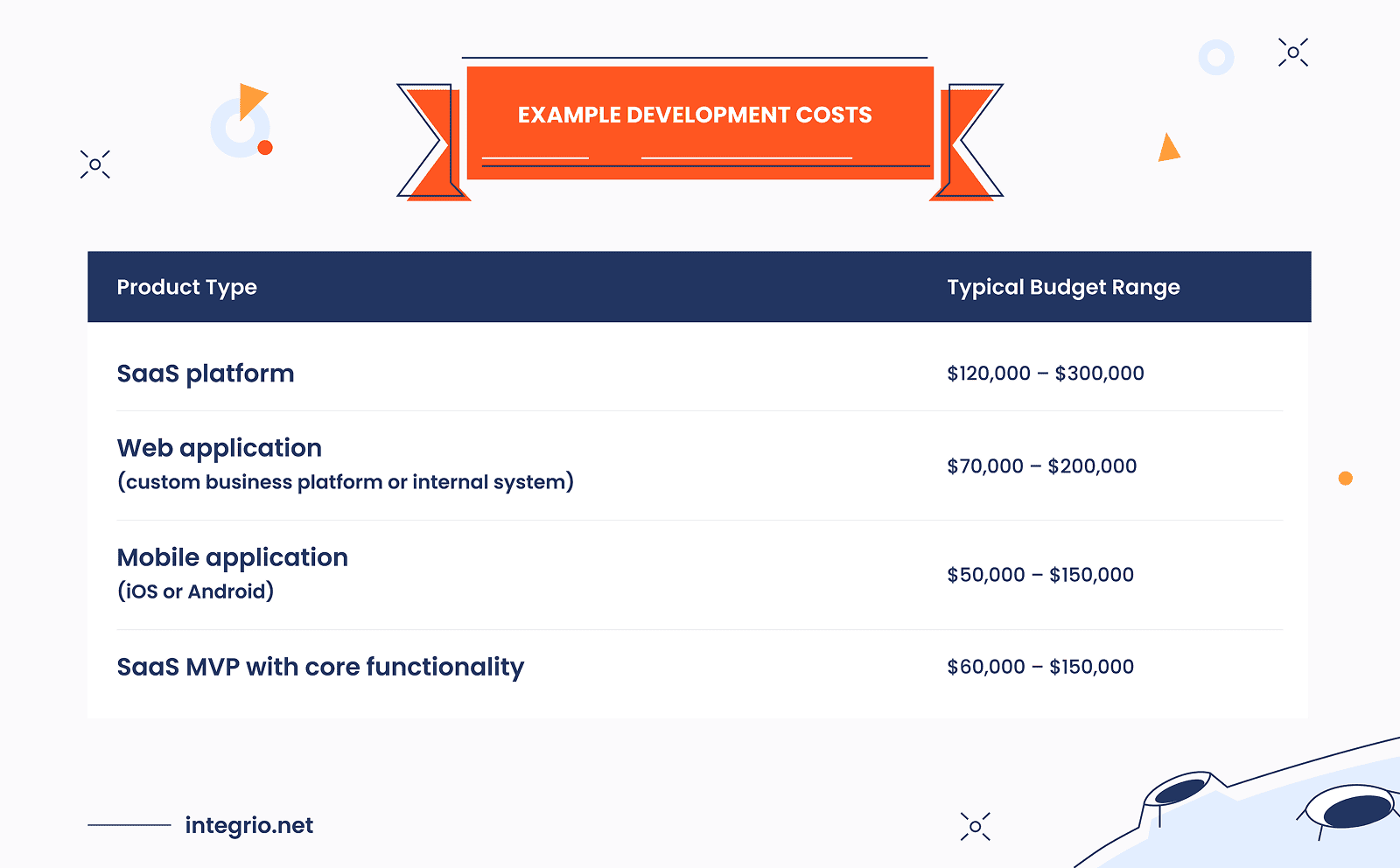
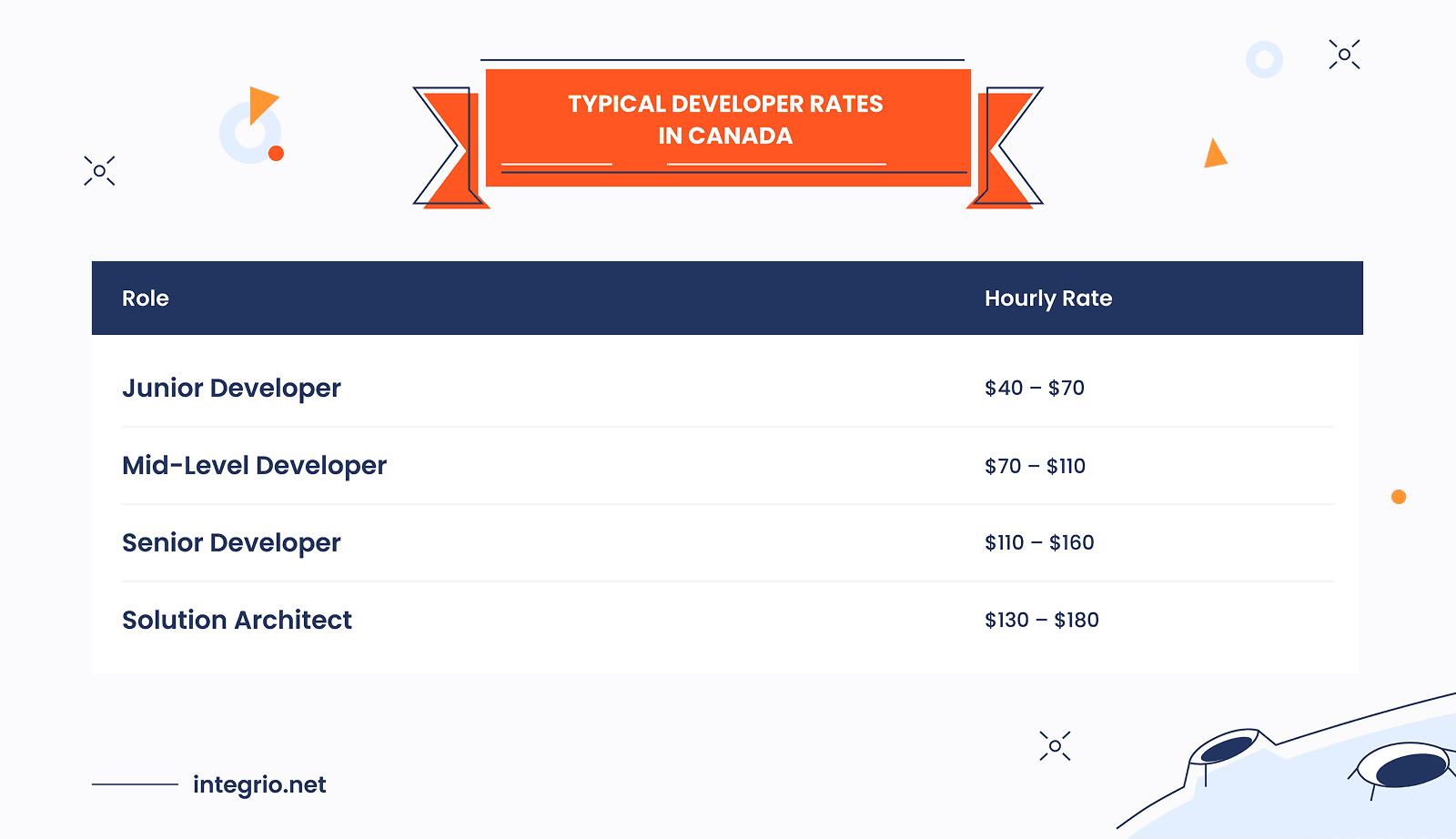
One of the most common worries about hiring software development and IT consulting companies in Canada is what the budget should be and what factors influence project expenses. We’ll show the average costs below, but right now, let’s talk about key factors in budget estimation.
First up is the complexity of your project and whether it requires additional functionality or integrations. Simply put, even a basic piece of software that has to be added into a tangled company ecosystem will have a higher budget as a result.
Next, consider how big a team you need and what kind of specialists it must include. That’s also influenced by project complexity, of course, and the platform you choose to develop for. Therefore, in many cases, a mobile application will cost less than a resilient SaaS platform.
Also, consider the project timeline: the longer it takes, the higher your expenses will be. While you can’t control certain circumstances, careful planning and transparent communication will help cut down on the development time and lower expenses.
Now, let’s take a look at some rates.
How to Hire a Software Development Company in Canada
Regardless of how complex the process of finding an outsourcing partner may seem, it gets easier when you take it step by step. So, let’s do just that.
Step 1: Start with a Local Search
Whether you’re asking fellow companies or using Google, limit your scope to software companies in Canada or, ideally, to your region. The search query can be as simple as “software development companies near me”. This will lower the number of potential candidates and keep you from being overwhelmed with thousands of options. Plus, they’ll be familiar with the specific market you’re operating in.
Step 2: Ask LLM Tools for Recommendations
Due to the sheer size of the Canadian software development market, even a simple local search can be time-consuming. You can narrow the range somewhat by using LLM tools to do the job for you. Write detailed prompts like “Which Canadian software development companies frequently collaborate with Canadian startups and can help with prototypes for securing funding?”
These help narrow the search window substantially and ensure you’re looking at companies within your niche. For example, writing “I’m looking for a reliable software development company in Canada that has experience building SaaS platforms” guarantees SaaS expertise.
Step 3: Shortlist, Verify, and Interview
Once you have a few solid selections, pick the best ones and verify their experience, preferably by confirming they’ve handled cases similar to yours. After that, schedule interviews with the most suitable candidates and assess their performance.
Key Contract Terms to Review Before Signing a Software Development Agreement
Even after finding and vetting a Canadian software development company you want to work with, the process of establishing your collaboration officially doesn’t end just yet. The last step you’ll need to begin work is to sign a contract.
Scope
Firstly, let’s discuss the question of scope, which determines how much work needs to be done and what the partnership's end-goal is. This should include specific project milestones and KPIs or quality benchmarks the team must meet. It’s this section that outlines the general direction of the work and limits what has to be done to fulfill the contract.
Payment Structure
Next, the question of payment and how it will be delivered. That means not just the overall sum but also the stages of payouts - a lump sum at the end, a monthly rate, or a multi-installment payment? Plus, negotiate the possibility of bonuses or fines, in case of incidents.
Ownership Clauses
One of the more common questions is who actually owns the finished product after an outsourcing partnership. You actually determine the answer to that by negotiating with your partner to decide who owns the IP, code, and product. The standard is that the client owns the software, but we suggest double-checking the wording in this part of the contract just in case.
Confidentiality and Consequences
As with any proprietary project, it’s in both your and the devs’ interests to ensure nothing about it leaks. But while you can simply trust your partner, it’s best to include stipulations regarding consequences for data leaks or non-disclosure clauses. For this reason and for the possibility of other force majeures, it’s crucial to define how the agreement can be terminated and on what grounds.
Conclusion
Our overview of outsourcing development projects to Canada is coming to an end, as we’ve covered:
Reasons to engage with the Canadian market
Core models for fruitful collaborations
Strategies and ideas that nurture partnerships
General cost expectations
Hiring and contract-compiling tips
All of this has laid the groundwork for you to find a software development firm in Canada that can bring your project idea to life and get it ready for deployment. However, there’s also a way to skip the search entirely. We talked a lot about the importance of managing communication, setting goals, and finding a trustworthy team. Well, Integrio Systems has all those points covered and more. Over 26 years of experience, we have gained the trust of countless clients with our hard work and skills.
HQ’d in Canada, with offices in Poland, Ukraine, and the US, we are an international team specializing in the healthcare and wellness industry, as well as SaaS product development. We don’t shy away from complex tasks, and our top priority is to exceed our clients’ expectations by putting in the work where it matters.
If you want a successful outsourcing collaboration, get in touch with Integrio Systems, and we can build a partnership that works for you.
FAQ
Same reason companies outsource in general: a desire to get a good product at a reasonable price point without having to go through the tedium of hiring tech experts. Sometimes, building a project in-house requires months of looking for the right talent and negotiating contracts with steep rates. Meanwhile, outsourcing cuts out the time and expenses associated with that, while the vast Canadian market offers plenty of diverse tech knowledge.
This depends on the company, though the most popular skills on the market nowadays will likely include AI training and development, VR/AR projects, ongoing maintenance, and QA. Most companies also offer either a full-stack process that covers everything or specialize in one specific part of development, e.g., front-end design or cloud architecture.
You can verify a company’s experience by checking typical review platforms such as Clutch and Trustpilot. These will not only confirm that a company has real cases but also highlight their strengths and weaknesses as seen by fellow clients. You should also check each candidate company’s website, as they may include additional case studies.
We use cookies and other tracking technologies to improve your browsing experience on our website. By browsing our website, you consent to our use of cookies and other tracking technologies.