Things aren’t easy for manufacturers these days. One report after another highlights the many challenges they have to grapple with: labor shortages, economic uncertainty, supply chain disruptions, outdated tech; the list goes on.
Unsurprisingly, technology becomes manufacturers’ main recourse for navigating these challenges. But that’s where things get complicated. Is an industry-specific (vertical) SaaS manufacturing solution better than a generic (horizontal) one? Or should you build a homegrown system altogether?
At Integrio, manufacturing solutions are our bread and butter. Over the past several years, we’ve noticed one trend: manufacturers are moving away from horizontal SaaS solutions, deeming them a bad fit for real-world manufacturing environments. Here’s why — and why vertical SaaS manufacturing solutions are emerging as a better investment for them.
What Is Vertical SaaS 2.0?
Vertical SaaS solutions are designed and built for a specific industry. Think products like Toast for restaurants, FieldData for agriculture, and Northbound for the supply chain industry. In manufacturing, examples include the Epicor Kinetic ERP and the MRPeasy material requirement planning system.
Thanks to their narrower domain focus, vertical SaaS products usually come with integrations and workflows more adapted to the industry. That’s why vertical SaaS goes hand in hand with higher revenues, even for non-business-critical software like CRM and BI tools.
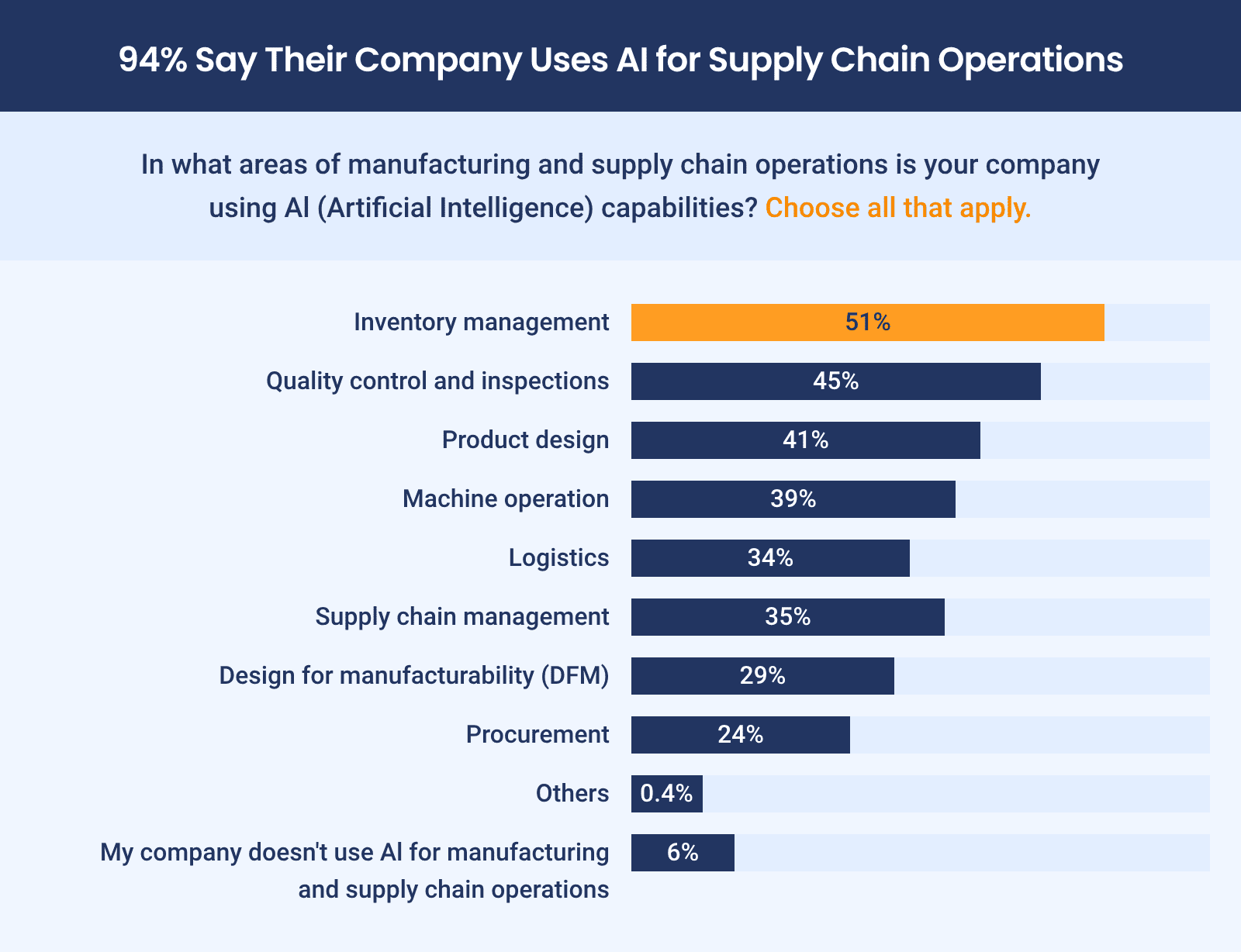
As for vertical SaaS 2.0, it’s a term coined for AI-first vertical SaaS products. In manufacturing, AI’s most common use cases include inventory management, quality control, and product design.
Unlike vertical SaaS manufacturing solutions, horizontal ones cast a wider net; they provide tech capabilities for one business function across multiple industries. Think Salesforce (CRM), Tableau (BI), and Notion (collaboration).
Quick refresher: Both horizontal and vertical solutions are SaaS products. That means customers pay a fee to use the application, while vendors take care of maintaining and updating it.
Why Horizontal Giants Fall Short in Manufacturing
Across industries, vertical SaaS products are outperforming their horizontal peers. They are showing higher net revenue retention and a lower new customer CAC ratio. One report also found that vertical SaaS products are more resilient and show lower churn.
But that’s across all industries. What about manufacturing?
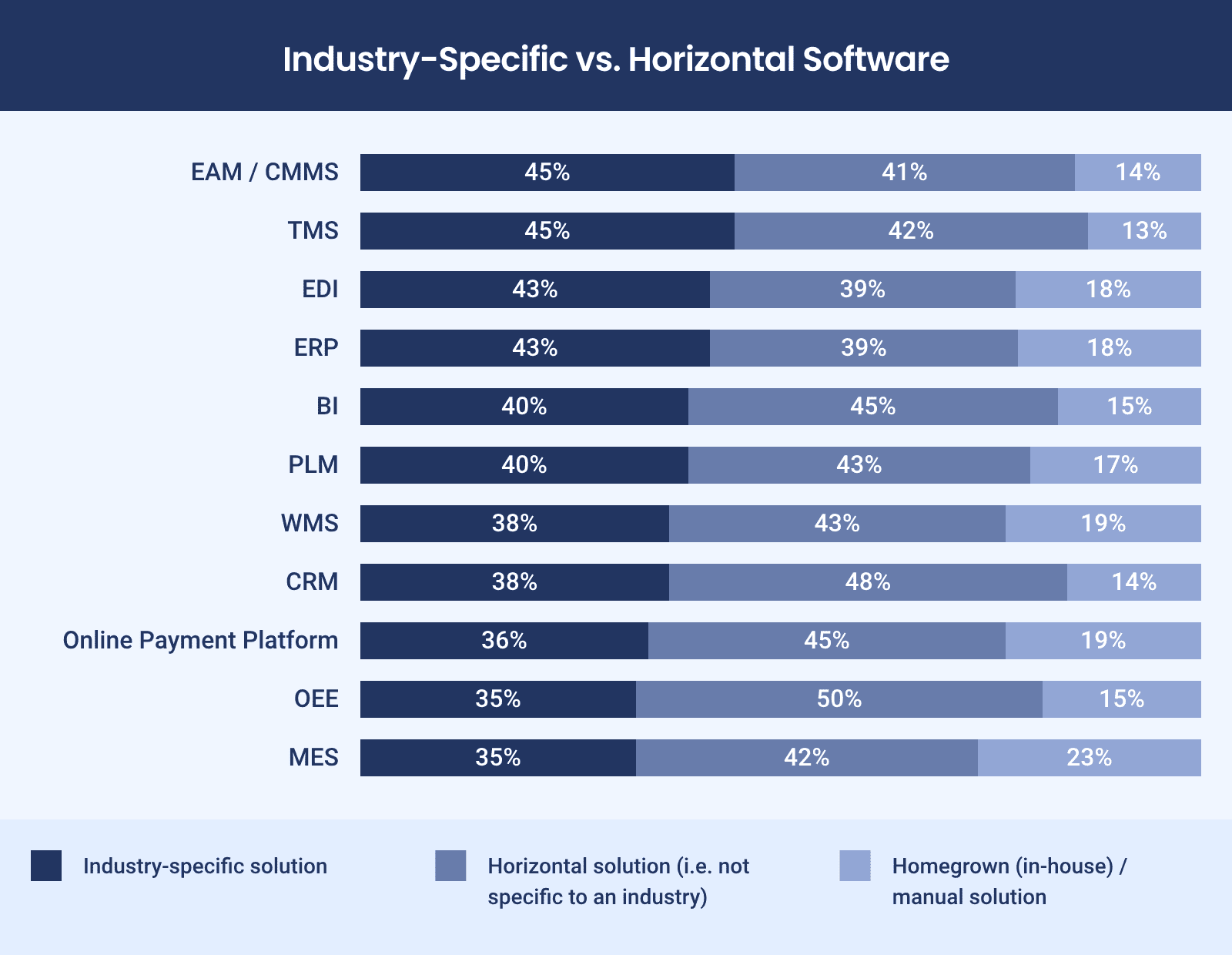
For now, the industry is somewhat split between vertical and horizontal products. Manufacturers are more likely to use industry-specific EAM (Enterprise Asset Management)/CMMS (Computerized Maintenance Management System), TMS (Transportation Management System), EDI (Electronic Data Interchange), and ERP solutions. BI, CRM, WMS (Warehouse Management System), online payment, and OEE (Overall Equipment Effectiveness) tools are more likely to be horizontal:
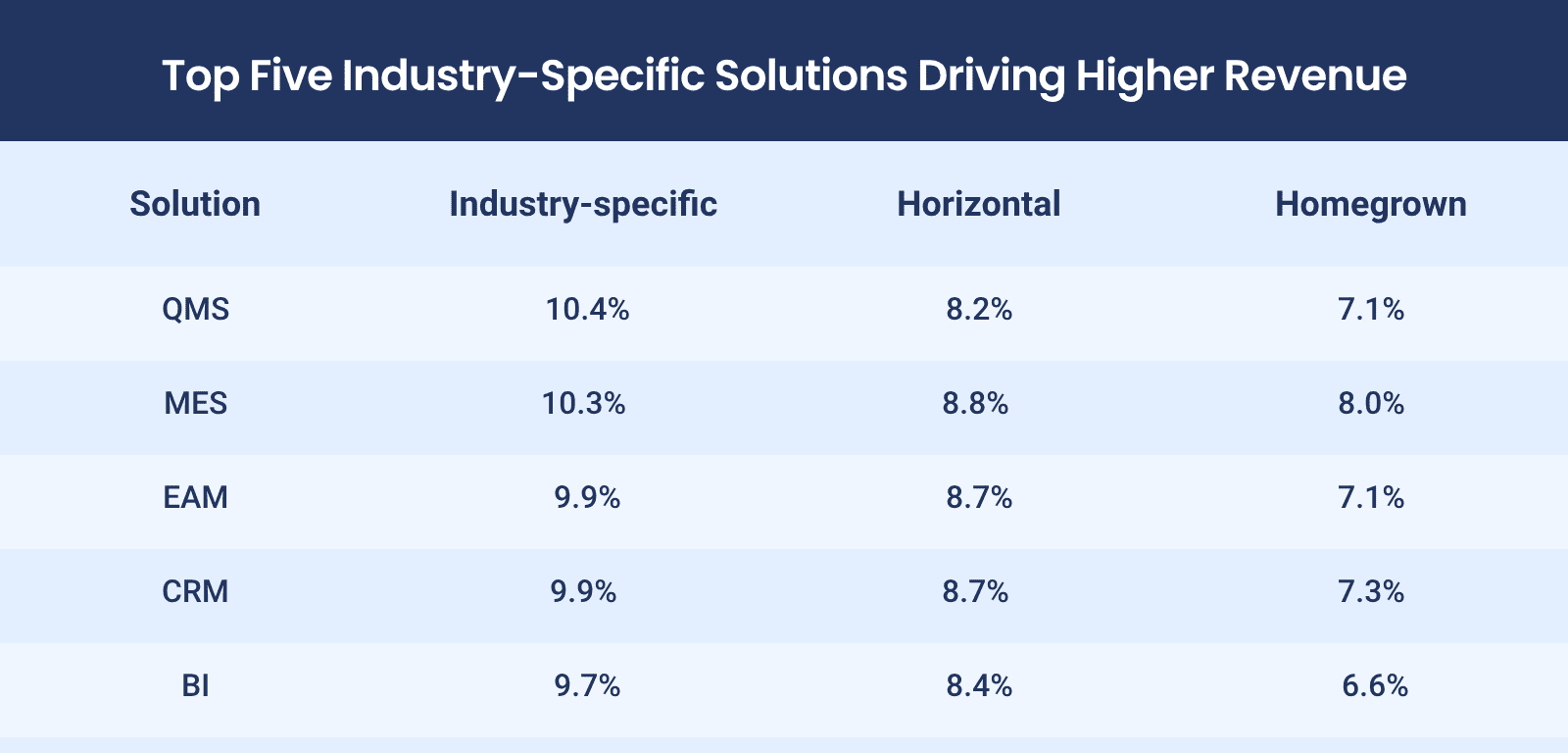
That said, using industry-specific QMS, BI, and CRM tools correlated with higher revenue growth rates:
A better fit to industry-specific needs could explain this trend. After all, a vertical manufacturing SaaS platform can offer targeted capabilities like:
Production planning: Full compliance for document management, production workflow automation, integrated procurement and resource management
Inventory optimization: Automated reordering, real-time inventory visibility, precise material requirement calculations, just-in-time (JIT) delivery support
Quality control: ISO and regulatory standard support, customizable attribute/variable control charts, root cause analysis tools
Dealer and distributor portals: Compliance with reporting regulations, automated approvals, integrations with product planning and inventory tools
Procurement workflows: Price forecasting for volatile raw materials, compliance with environmental and safety standards, compliance with due diligence regulations
Predictive maintenance: Integrations with industrial IoT platforms, CMMS, and ERP systems; adaptive baselines and maintenance schedules
Making The Case for Niche Manufacturing Software
Simply put, generic software falls into the “lowest common denominator” trap. Horizontal software vendors need to appeal to the widest audience possible. So, they make a workflow as generic as possible.
Sure, you might be able to customize the workflow to fit your processes. But that takes time and money — and it probably won’t be a perfect fit.
In contrast, niche manufacturing software covers those industry-specific needs out of the box. For example:
Quality control systems can ensure compliance with IEC 60335 for home appliance manufacturers out of the box.
Dealer portal manufacturing solutions can easily automate warranty claims and recalls.
An industrial manufacturing ERP enables level-one traceability via automated serial number matching between the assembly line and purchased materials.
Manufacturing workflow software automatically creates a paper trail that tracks domain-specific CAPAs (corrective and preventive actions), deviations, and nonconformities.
Be it a QMS or ERP, niche manufacturing software creates several tangible advantages for adopters:
Faster implementation. There’s no need to customize the solution to make it fit established processes or connect it with other niche tools via custom APIs.
Gentler learning curve. It’s easier to train workers to use a tool like production planning SaaS if it already reflects their day-to-day workflows. That brings down training costs and boosts user adoption.
Fewer workarounds. When a horizontal tool fails to adapt to your needs, spreadsheets pick up the slack. Removing the need for workarounds speeds up workflows and prevents mistakes and data silos.
Better operational visibility. Industry-specific integrations ensure that the new tool can seamlessly exchange data with other systems. This facilitates automation and enhances visibility into real-time processes and historical trends.
Build vs Buy for Manufacturing Software
Although custom manufacturing software remains a minority among manufacturers, it’s still an option worth considering. As an experienced enterprise software developer, we can attest: custom-built manufacturing software can be the solution you’ve been looking for.
How will you know if that’s the case? In our experience, the general build vs buy analysis boils down to:
Build if:
Buy if:
Your operations are truly unique compared to competitors
Your software-related workflows are fairly standard
You’ll use the system as the core IP to differentiate from competitors
You need a new tool now, so implementation has to be quick
Your system requires a plethora of custom integrations, especially with legacy tech or custom tools
You don’t expect the system to give you a competitive edge
That said, each case is unique. Evaluate your resources, differentiation needs, and technical and business constraints before committing to either of the options.
Why Vertical SaaS 2.0 Is Growing Now
In manufacturing, AI is the number one trend that impacted manufacturers’ strategy in 2025, ahead even of economic headwinds. AI adopters are seeing faster revenue and profit growth, too (9.1% vs 7.3% and 7.6%, respectively, in 2024).
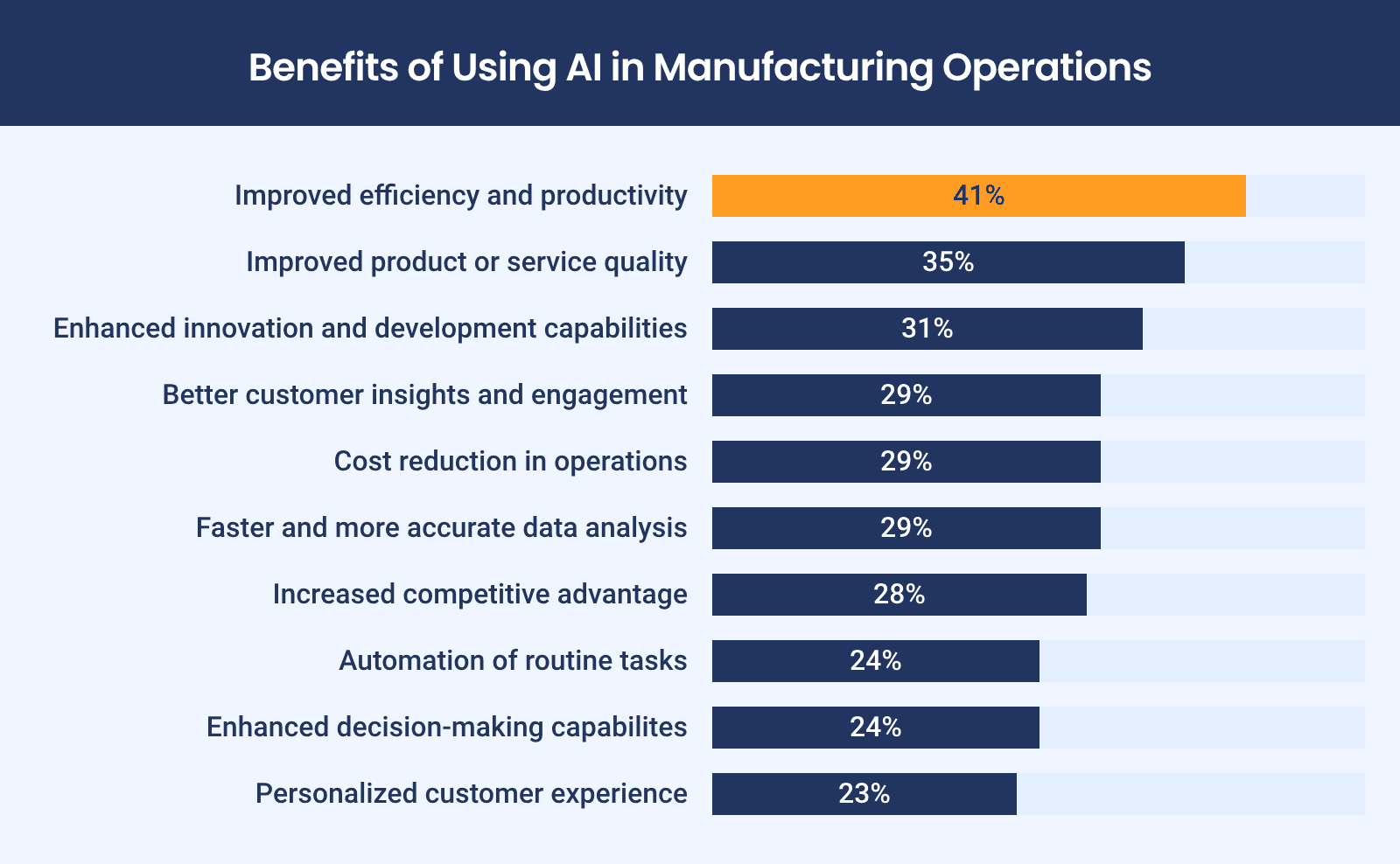
AI manufacturing SaaS can help adopters reap benefits like improved efficiency, product quality, and innovation capabilities:
While not all vertical SaaS products are 2.0, vendors seem to be going all in on AI. As of 2025, 55% of vertical SaaS vendors offer AI products or services, and another 30% expect to launch one within 12 months. According to the same report, customers are clamoring for AI features, with the mean attach rate skyrocketing from 42% in 2024 to 80% in 2025.
Why is vertical SaaS 2.0 outperforming its non-AI competitors? The reason is simple: vertical SaaS can offer its users something that horizontal AI vendors can’t: context-aware AI features.
Training AI models exclusively on domain-specific data allows them to excel at industry-specific tasks. For example, an AI-first manufacturing ERP alternative can “know” how to optimize furnace performance for steel manufacturers out of the box. Horizontal SaaS vendors that target a dozen industries simply can’t afford to do the same and run a dozen domain-savvy AI models.
How Integrio Systems Helps Manufacturers
At Integrio, we understand the tremendous impact a single software system can have on manufacturing operations. We’ve built custom manufacturing platforms that made quality compliance times easier, minimized human error, and enabled manufacturers to stay one step ahead of workflow and production issues.
Our expertise spans:
AI-driven operations tools (e.g., production scheduling, requirements planning)
Forecasting solutions for predictive maintenance and production optimization
Production line, service, and maintenance automation systems
Of course, we also understand full well that outdated tech weighs some manufacturers down. We also offer legacy modernization services to help manufacturers mitigate cybersecurity risks and adopt technologies such as AI/ML.
Need real-world examples? Look no further than our CamTran case study. Following a tender, this Canadian oil-filled distribution transformer manufacturer partnered with Integrio to build a work instruction management tool. Jive, as it was christened, was a pilot project. Following its success, we helped CamTran grow it into a full-fledged ERP with:
Quality control
Production and inventory management
Production volume and financial results forecasting
Project management
Jive became a competitive differentiator for CamTran and even caught the eye of BC Hydro’s auditors in 2019. They noted that the tool was easy to use and best-in-class for production and work control.
Conclusion
Try as they may, generic solutions won’t ever meet the unique needs of manufacturers down to the tiniest details (lest they’re ready to launch a separate product altogether, that is). That’s why vertical SaaS for manufacturers is winning: it’s faster to implement, requires fewer customizations or workarounds, and offers better operational visibility.
Not sure how to leverage technology to optimize operations and secure a competitive advantage? Integrio has spent over two decades helping manufacturers make the right choice and turn it into reality. Get in touch with us to discuss your specific challenges.
FAQ
Vertical SaaS refers to cloud-based software built for a specific industry and distributed as-a-service. Unlike its horizontal counterparts, vertical SaaS tools adapt to industry-specific workflows, operational constraints, and compliance requirements.
Manufacturers often require features that generic solutions lack (e.g., FDA compliance, ISO-aligned quality control). They also have strict compliance requirements that generic tools may not account for.
The short answer is, it depends. Off-the-shelf ERPs can be easier to implement. Custom ones, however, can be integrated with any legacy systems and provide a competitive advantage via proprietary algorithms.
The product’s complexity always determines the costs, since it defines the time and expertise required to build it. If you have a vertical SaaS product in mind, we’d be glad to discuss it and provide a free estimate.
The answer depends on the purpose of the SaaS tool. Across SaaS tools, however, automated compliance tracking, predictive maintenance, AI-powered forecasting, and real-time monitoring are common features.
Custom software can provide a competitive advantage, meet unique operational needs, and match extreme compliance and integration requirements.
We use cookies and other tracking technologies to improve your browsing experience on our website. By browsing our website, you consent to our use of cookies and other tracking technologies.